



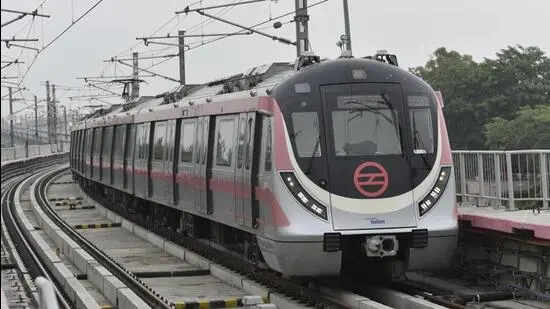
The Delhi government’s public works department (PWD) has approved the transfer of 24 acres of land in Majlis Park to the Delhi Metro Rail Corporation (DMRC) for the construction of a depot for upcoming Phase 4 metro corridors, said officials aware of the matter on Tuesday.
The land, located near the existing depot in Mukundpur in north Delhi, will be handed over at a cost of ₹238.71 crore, based on provisional land rates fixed by the Delhi Development Authority (DDA) for the financial years 2022-24.
PWD minister Parvesh Verma said the transfer of land will help expedite infrastructure creation for Delhi Metro’s expansion under Phase 4.
“The Delhi government is committed to supporting expansion of public transport infrastructure in the capital. The transfer of land in Majlis Park will facilitate timely development of the metro depot required for Phase 4 corridors,” he said.
PWD officials said DMRC had in November and December last year sought transfer of the land for construction of a depot under Phase 4 of the Mass Rapid Transit System (MRTS).
According to officials, 14.31 acres falling in Pocket H2(B) and 9.69 acres in Pocket H2(C) will be transferred to DMRC. The rate has been fixed at ₹9.9 crore per acre, taking the total cost to ₹238.71 crore.
The PWD has asked DMRC to furnish an undertaking confirming acceptance of the conditions laid down by the department and deposit the amount through a demand draft or cheque before formal permission is issued.
The communication sent by PWD stated that the land rates are provisional and DMRC will have to pay any differential amount if DDA or the ministry of housing and urban affairs revises land rates in the future. The agency has also been directed to use the land exclusively for the purpose for which it is being transferred and not create any third-party rights without prior approval of the Delhi government.
The conditions also specify that the land is being handed over on an “as is, where is” basis and that DMRC will be responsible for restoration of any damaged infrastructure, shifting of utilities and compliance with safety, traffic and environmental norms during the execution of work.
Officials said metro depots are critical for stabling, maintenance and operation of trains for new corridors being developed under the ongoing expansion phase.