


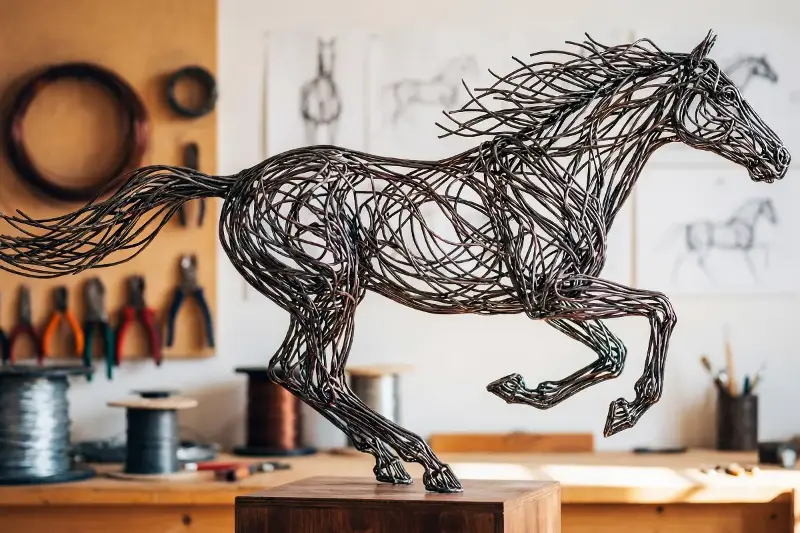
A single length of wire can appear weightless in an artist’s hands, yet it rapidly transforms into a soaring figure, a drifting cloud, or a leaping animal balanced on a single point. As one of the most direct mediums in contemporary art, wire offers an honest, transparent experience. Nothing is hidden beneath paint or stone; every bend, joint, and shadow remains entirely visible.
Artists who work with wire create a powerful illusion of movement and suspension. Their creations seem to float or lean impossibly far without falling. The secret is not magic, but rather a brilliant fusion of physics, structural engineering, and artistic imagination.
From Industrial Material to Fine Art
Wire was originally manufactured for practical everyday uses like fencing, electrical systems, and construction. Its artistic potential exploded during the early twentieth century when modernist pioneers began experimenting with ordinary industrial items. Alexander Calder played a revolutionary role by turning wire into an expressive sculptural language, using continuous lines to craft delicate portraits, circus performers, and kinetic works.
Unlike clay or marble, wire sculpting is an additive process similar to drawing in real space:
- Building with lines: Forms are constructed by adding contour rather than carving away mass.
- The power of empty space: The open air inside an outline suggests volume, muscle, and personality without needing solid surfaces.
- Material variety: Artists work with aluminium (light and flexible), copper (warm with a natural patina), brass, and heavy steel for outdoor installations.
The Physics Behind the Illusion
Gravity is ever-present, but skilled artists learn to balance against it effortlessly. The key lies in mastering the center of gravity—the precise point where an object's weight is concentrated. If that point aligns directly over the support base, the structure stands firm.
To make a sculpture appear to jump or hover, makers rely on clever structural techniques:
- Hidden supports: Internal steel rods are frequently disguised inside a leg, a wing, or flowing drapery to support a figure balancing on one toe.
- Strategic counterweights: Weight is offset using elements disguised as hair, branches, or flowing abstract curves behind the main form.
- Tension and compression: Tightly stretched lines work alongside curved wires pushing against each other, allowing surprisingly thin elements to share heavy loads safely.
Drawing in Three Dimensions
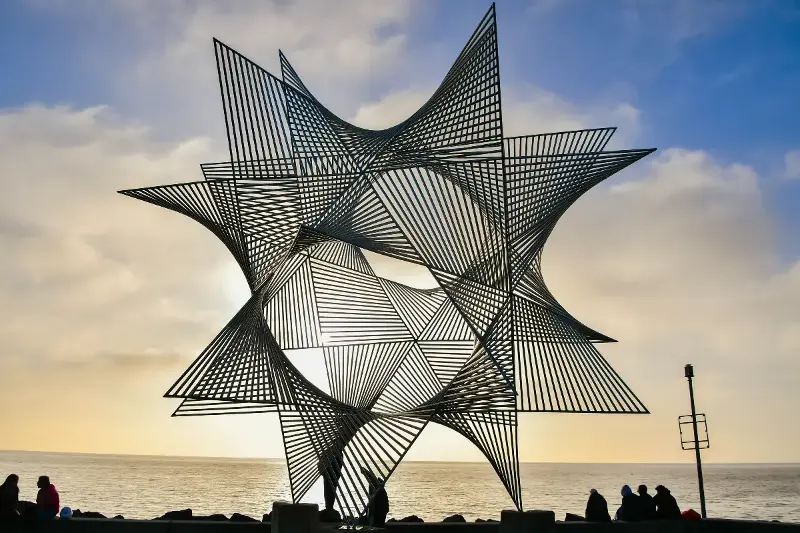
Wire art actively invites viewers to move around the piece. From one angle, a work might look like an abstract gesture; step to the side, and it instantly reveals a human face or a bird in flight.
Artists translate quick life sketches into metal using tools such as pliers, hammers, and welding torches. The choice of joinery shapes the final aesthetic: twisting wire leaves an energetic, handmade texture, while soldering and welding offer clean, durable connections for complex designs.
Light, Shadow, and Spatial Harmony
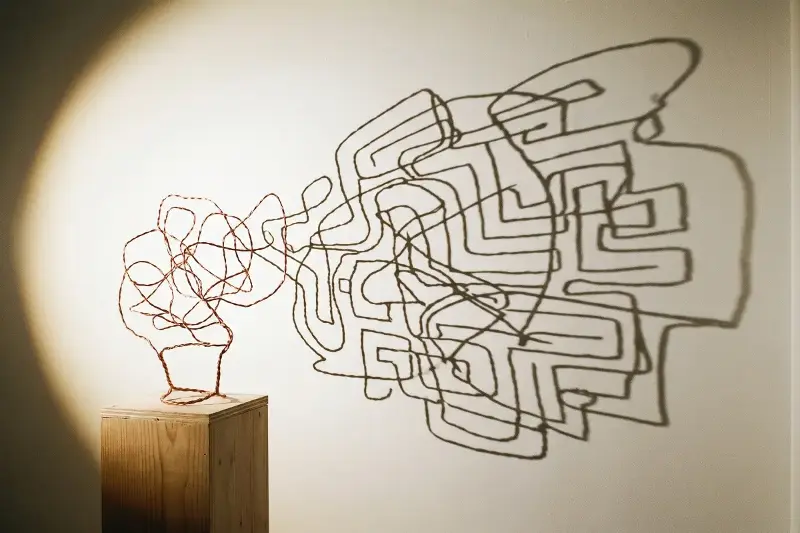
Because wire structures are open rather than solid, their interaction with light is truly captivating. Sunlight or spotlights pass straight through the metal, projecting dynamic shadow drawings across nearby walls and floors. As daylight shifts, the artwork evolves along with it.
This transparency creates a striking emotional weight. A life-sized wire figure can feel both physically present and ghostlike—resembling a memory or a fleeting thought. Today's contemporary artists continue to expand the medium by integrating recycled electrical cables, found objects, fabric, and glass.
Why the Medium Continues to Fascinate
Wire sculpture serves as a vivid reminder that art does not require heavy materials to feel monumental. A simple curve can capture wind or speed, while a hidden balance point lets solid metal float. In the hands of an inventive artist, humble wire leaves the flat page behind and gracefully learns to defy gravity.