



A mechanical watch has no battery, no circuit board, and no need for a charging cable. Yet, when properly maintained, it can keep time for decades or even centuries. This enduring appeal stems from a remarkable combination of engineering, craftsmanship, and physical principles that have changed surprisingly little since the first portable timepieces appeared in the 16th century.
In an age defined by instant upgrades and disposable electronics, a mechanical watch offers something distinctly different. It is a compact, fully repairable machine designed to turn stored energy into measured time. Its intricate movement can be observed, adjusted, cleaned, and rebuilt by skilled hands—one major reason these timeless devices never truly fade.
A Machine Powered by a Spring
At the absolute heart of a mechanical movement is the mainspring—a tightly coiled strip of specialized steel or modern alloy stored inside a barrel. Winding the crown tightens this spring to store potential energy. As the spring slowly unwinds, it drives a precise sequence of gears that turn the hands around the dial.
Key aspects of mechanical power delivery include:
-
Generous Power Reserves: A typical hand-wound watch runs for 38 to 48 hours on a full wind, while advanced models offer reserves of 70 hours, five days, or longer.
-
Automatic Convenience: Self-winding watches utilize a weighted rotor that swings with daily wrist motion, continuously winding the mainspring as you move.
-
Controlled Energy Release: Without proper regulation, the mainspring would unwind instantly, sending the watch hands spinning wildly instead of marking steady time.
The Escapement's Remarkable Job
The mechanism responsible for regulating this energy is the escapement—widely considered one of the most vital inventions in horological history. The escapement allows the gear train to step forward in tiny, measured increments while transferring subtle impulses to the balance wheel.
This complex rhythm forms the heart of mechanical timekeeping:
-
The Ticking Rhythm: The balance wheel and its micro-thin hairspring act as an oscillator, swinging back and forth like a microscopic pendulum.
-
High-Speed Frequencies: Many modern movements oscillate at 28,800 vibrations per hour ($4\text{ Hz}$), dividing each second into eight precise micro-steps.
-
Visual Elegance: Unlike the single, abrupt jump of a quartz second hand, a mechanical watch creates a smooth, sweeping motion across the dial.
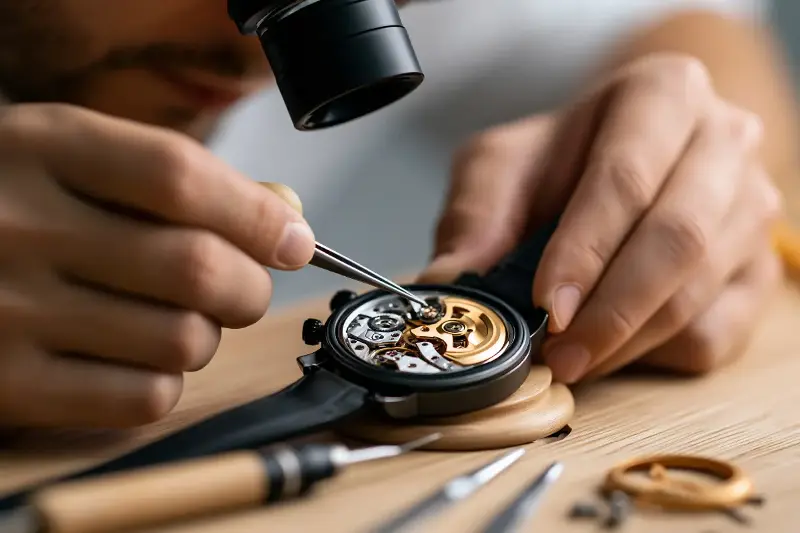
Tiny Parts, Enormous Precision
A traditional mechanical movement houses over 100 components—with complex models containing several hundred. These components include gears, levers, springs, screws, and bridges, many smaller than a grain of rice.
To preserve accuracy and longevity, watchmakers rely on clever materials and modern innovations:
-
Synthetic Ruby Jewels: Positioned as bearings where metal pivots rotate, hard ruby surfaces dramatically reduce wear and friction.
-
Anti-Magnetic Hairsprings: Crafted from silicon or advanced alloys to resist strong magnetic fields.
-
Shock-Protection Systems: Engineered spring bearings cushion delicate balance pivots against accidental drops or impacts.
While a finely regulated mechanical watch may gain or lose a few seconds per day—compared to quartz technology's seconds per month—enthusiasts value the extraordinary achievement of achieving reliable time through pure physical motion.
Designed to Be Serviced, Not Discarded
Unlike modern consumer electronics built with planned obsolescence in mind, mechanical timepieces are crafted to be restored. Over time, oils dry out and microscopic dust enters the case, requiring a complete professional overhaul.
A typical full service includes:
-
Complete Disassembly: Taking apart every bridge, gear, and lever.
-
Ultrasonic Cleaning: Stripping away aged lubricants and micro-debris.
-
Precision Lubrication & Tuning: Applying fresh oils, replacing worn parts, and recalibrating timing.
This longevity explains why vintage timepieces from decades past remain fully operational today. The underlying mechanical logic remains timeless, immune to changing operating systems or discontinued software updates.

A Connection Between Engineering and Human Skill
Beyond technical utility, mechanical watches survive because they bridge technical design and artistic devotion. Movements are frequently finished with hand-polished bevels, striped Geneva waves, blued steel screws, and detailed engravings.
Horological complexity shines brightest through complications:
-
Everyday Enhancements: Date windows and dual-time displays.
-
Advanced Engineering: Chronographs, moon-phase indicators, and minute repeaters.
-
Perpetual Calendars: Intricate gear networks that automatically track leap years and varying month lengths for decades without manual adjustment.
Ultimately, a mechanical watch is far more than a tool to display the hour. It is a compact masterclass in materials science, physics, and patience—offering a daily connection to a living machine whose inner workings will continue to make sense long into the future.