


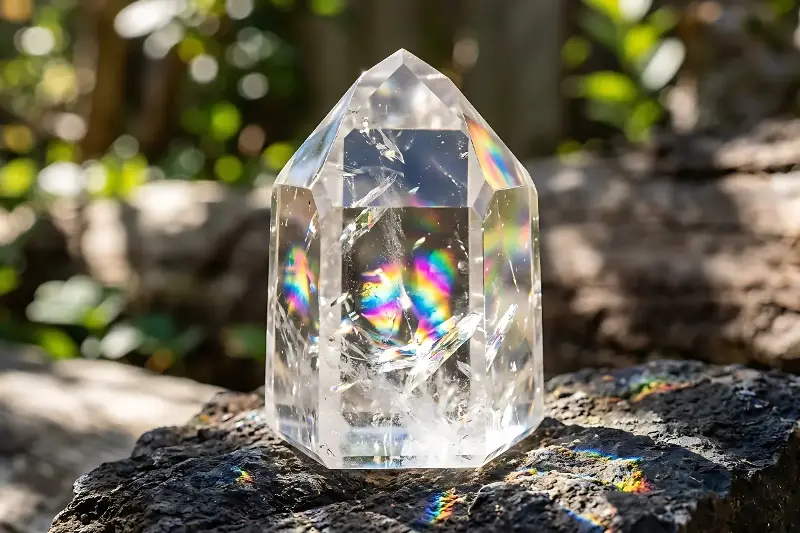
Glass begins with one of Earth’s most ordinary materials: sand. Yet the journey from dull grains to a perfectly clear window, bottle, or laboratory lens is a remarkable story of intense heat, chemistry, and precise industrial control. Clear glass looks simple because its finished surface is smooth and transparent, but its internal structure is far more unusual than that of most solid materials.
Ancient Origins in Natural Heat
The earliest people who encountered glass may have found it in volcanic regions:
-
Obsidian: A naturally occurring volcanic glass formed when lava cools so rapidly that its atoms cannot arrange themselves into crystals.
-
Early Applications: Ancient societies valued obsidian for its sharp cutting edges, mirrors, ornaments, and essential tools.
-
Manufactured Glass: Appeared much later, with historical evidence of glassmaking emerging in Mesopotamia and Egypt around the third millennium BCE.
Why Sand Can Become Glass
The key ingredient in most modern clear glass is silica (silicon dioxide), which is abundant in quartz-rich sand, sandstone, and many rocks. On its own, pure silica requires temperatures above 1,700°C to melt, making production energy-intensive and technically demanding.
Glassmakers solve this challenge by blending silica sand with key additives:
-
Soda Ash (Sodium Carbonate): Functions as a flux to lower the melting temperature of silica, making large-scale production practical.
-
Limestone (Calcium Carbonate): Supplies calcium oxide, which improves chemical durability and prevents the glass from dissolving in water.
This widely used formula is called soda-lime-silica glass. It makes up roughly 90% of glass produced worldwide, comprising about 70% silica alongside soda and lime.
A Solid That Behaves Like a Liquid
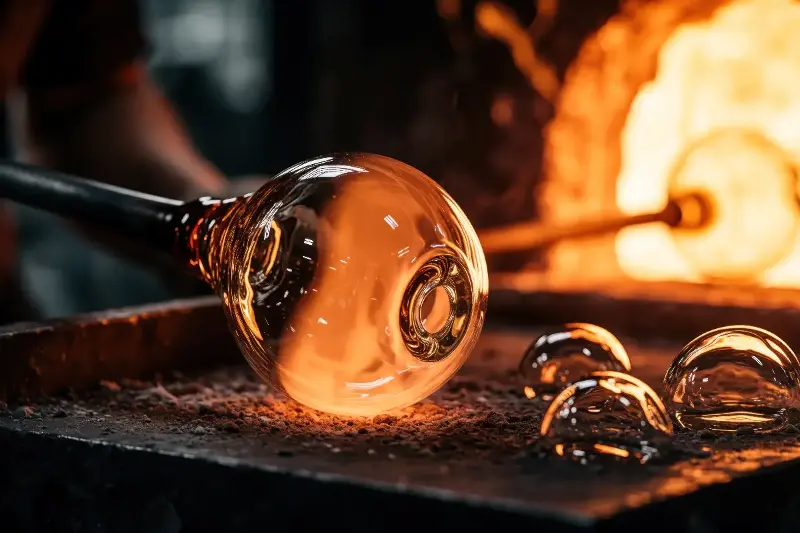
Glass is scientifically described as an amorphous solid. Unlike a crystal, its atoms do not form a repeating, orderly pattern:
-
Molecular Network: When glass cools from a molten state, its atoms become locked into a disordered network before crystals can develop.
-
Distinct Qualities: This structure makes glass transparent, hard, chemically resistant, and easily shaped while hot.
-
The Window Myth: Glass is not a slow-moving liquid at room temperature. Historical window panes are thicker at the bottom due to older, uneven manufacturing techniques rather than centuries of slow flow.
The transition from molten material to solid glass occurs gradually through a range known as the glass transition, becoming increasingly rigid until it behaves like a solid.
The Secret of Optical Clarity
Not every sand can produce sparkling clear glass. Natural sand contains iron compounds, clay, and organic matter. Even a tiny trace of iron can tint glass green, blue-green, or brown.
Creating high-clarity glass requires meticulous refining:
-
Low-Iron Sand: Selected specifically to prevent color tinting.
-
Refining Agents: Added to help tiny gas bubbles rise out of the melt, ensuring light is not scattered or distorted.
-
Controlled Additives: While clear glass limits light-absorbing substances, deliberate additions of metal oxides can create vivid colors—such as cobalt for deep blue or manganese for purple.
From Furnace to Flat Window
Modern glass production is a continuous process operating at furnace temperatures near 1,500°C. Factories often add cullet (crushed recycled glass), which melts quickly, saves energy, and can be remade repeatedly without losing quality.
For flat windows, the industry relies on the float glass process:
-
Liquid Tin Bath: Molten glass flows onto a bath of liquid tin, spreading into a perfectly smooth, glossy ribbon.
-
Annealing Lehr: The ribbon travels through a temperature-controlled tunnel that cools the glass slowly and evenly to relieve internal structural stresses.
Strength Beyond Fragility
Advanced engineering allows glass to achieve exceptional durability and versatility:
-
Tempered Glass: Rapidly cooled to place outer surfaces under high compression, making it several times stronger than ordinary glass and causing it to crumble into small, blunt pieces when broken.
-
Laminated Glass: Binds multiple glass sheets around a plastic interlayer, holding fragments together upon impact for vehicle windshields and security windows.
-
Modern Innovation: Enables low-emissivity window coatings, durable device touchscreens, optical fibers for global data transmission, and high-efficiency solar panels.
From ancient ornaments to modern skyscraper façades, clear glass remains a material of quiet brilliance—blending mineral selection, molecular disorder, and industrial precision.