


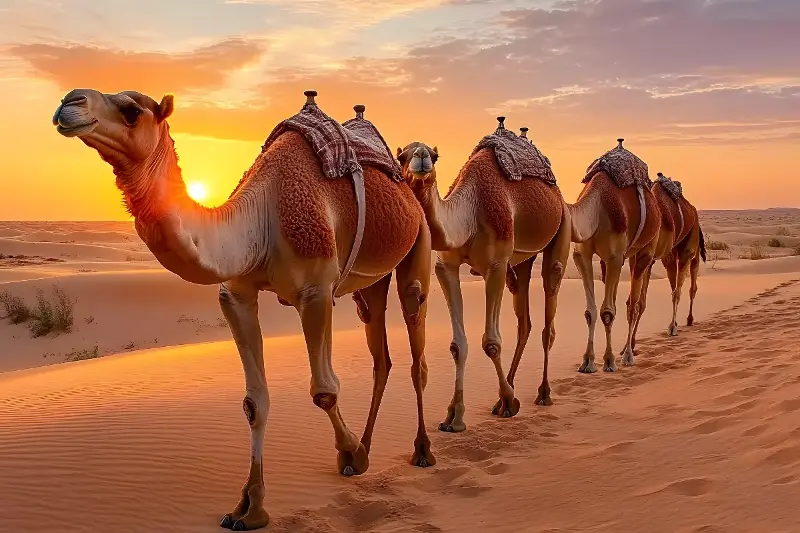
Across arid landscapes and shifting sands, camels have quietly roamed the earth for millions of years, their story woven into the very fabric of human civilization. These remarkable creatures have inspired awe, fueled empires, and helped shape the course of history. While their iconic humps and long eyelashes may be familiar, the true world of camels is filled with surprises waiting to be discovered.
MASTERS OF SURVIVAL: NATURE’S ULTIMATE DESERT ENGINEERS
Camels have long been known as the “ships of the desert”, a title earned through unique adaptations that allow them to thrive where few animals can. Their physiology is a masterclass in biological engineering:
- The Hump Myth: Contrary to popular belief, humps do not store water. They store fat, which is metabolized for energy and a small amount of water during long journeys.
- Sand Protection: Their nostrils can close completely to block grit, while thick, double-row eyelashes and bushy eyebrows shield their eyes from the sun.
- Unique Blood: They possess oval-shaped red blood cells, which allow them to flow easily even when the animal is severely dehydrated—a trait that would cause other mammals' blood to thicken and stop.
- Heat Regulation: Camels can withstand dramatic changes in body temperature, minimizing water loss by not sweating until it is absolutely necessary.
A HISTORICAL PARTNERSHIP: THE RISE OF CIVILIZATION
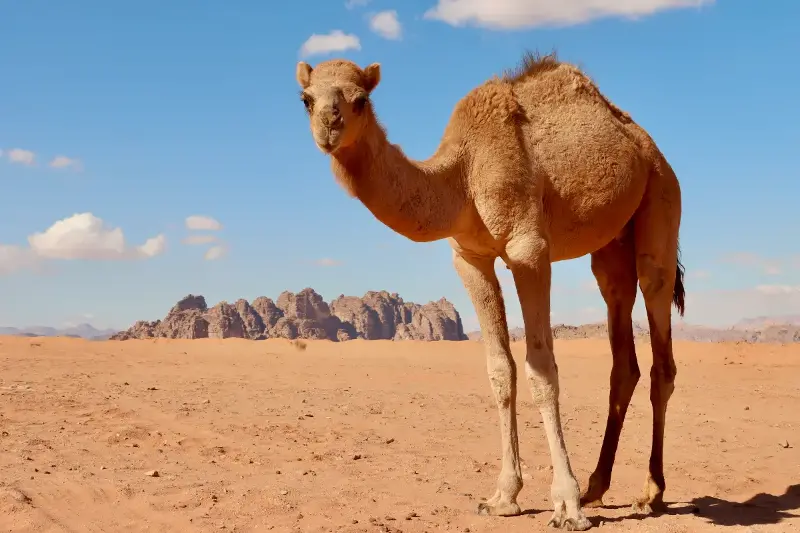
The connection between humans and camels stretches back more than 4,000 years. Both dromedaries (single-humped) and Bactrian camels (double-humped) have fulfilled indispensable roles in global history.
Camels acted as the lifeline of the Silk Road, carrying spices, silk, and precious gems across thousands of kilometers. These animals made trade between China, India, the Middle East, and Europe possible, effectively laying the groundwork for global commerce. In remote areas today, they remain vital sources of milk, meat, and hides. Notably, camel milk is considered a “superfood”, rich in vitamins and naturally lower in lactose than cow's milk.

CAMELS IN CULTURE, MYTH, AND SCIENCE
With their striking features, camels have found a place in legends and spiritual life. In Islamic tradition, the Prophet Muhammad had a favorite camel named Qaswa. In ancient Egypt, they were sometimes seen as sacred guides, while Chinese art celebrates the camel as a figure of endurance and resilience.
Modern science is now unlocking the secrets behind their marvels. Researchers study camel antibodies, which are significantly smaller and more stable than those of other mammals, opening doors to breakthroughs in medicine. Even NASA looks at camel adaptation mechanisms to inspire technology for machines sent to harsh environments like Mars.
UNEXPECTED CAMEL FACTS THAT DEFY STEREOTYPES
Camels are often unfairly labeled as bad-tempered, but they are actually social and highly intelligent creatures capable of forming deep bonds with humans. Here are a few facts that challenge the common narrative:
- American Origins: Camels actually originated in North America over 40 million years ago before migrating to Asia and Africa.
- Australian Giants: Australia currently boasts the largest population of wild (feral) camels in the world, following their importation in the 19th century.
- Endurance Athletes: Camels can outpace horses over long distances, traveling up to 100 miles in a single day if water is available.

MODERN CAMELS: RACING TRACKS TO SUSTAINABLE SOLUTIONS
In the Middle East, camel racing remains a prestigious sport. Interestingly, it has embraced the future; robot jockeys have largely replaced human riders, blending ancient heritage with cutting-edge robotics.
Beyond the track, camels are gaining attention in the fight against climate change. Their ability to thrive on scrubby vegetation and their minimal water requirements make them ideal for sustainable grazing programs in fragile ecosystems. From ancient caravans to modern labs, camels remain the unsung heroes of human progress, proving that they are much more than just desert dwellers.