



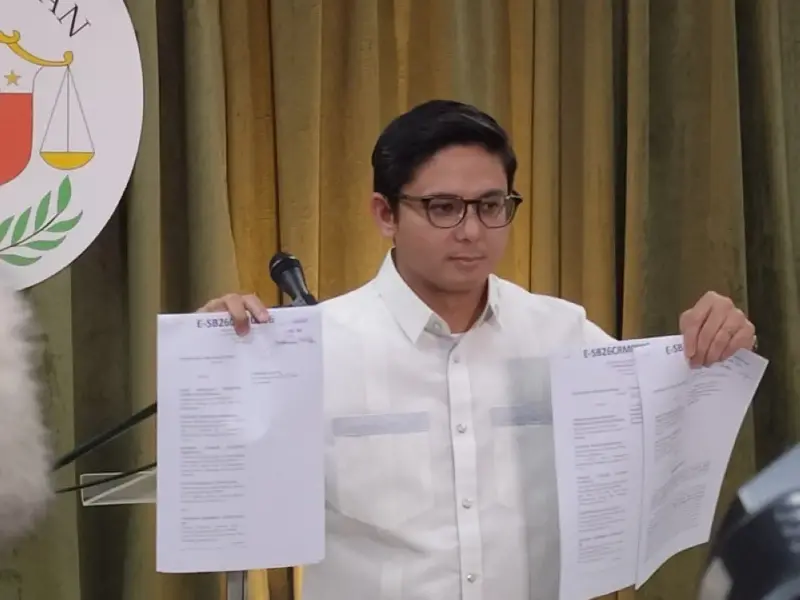
THE Office of the Ombudsman on Thursday filed plunder and graft charges against Sen. Jinggoy Estrada, former Public Works secretary Manuel Bonoan and three other people before the Sandiganbayan.
“The Office of the Ombudsman has recommended no bail for the respondents in this case,” Assistant Ombudsman Mico Clavano said in a press briefing after the cases were filed in court. “Likewise, the office will pursue hold departure orders for the respondents so as to preserve the integrity of the case in court.” Later on Tuesday, the cases were raffled off to the Sandiganbayan divisions that would issue arrest warrants if probable cause is found.
Estrada and Bonoan were the accused in the graft case that was raffled off to the Sandiganbayan Second Division. In the other graft case, which was raffled off to the court’s Fifth Division, the accused were Estrada, Bonoan, former Department of Social Welfare and Development (DPWH)-National Capital Region officials Denryl Caesar Cortuna, Manny Bulusan and Arturo Gonzales Jr. All five were named as accused in the plunder case, which was raffled off to the Fifth Division.
If a court division finds probable cause, that division will issue an arrest warrant.
Estrada: No due process
Estrada on Thursday said he will exhaust all legal remedies to face the plunder charges filed against him before the Sandiganbayan.
He noted that ever since the Senate leadership changed on May 11, the resolution of cases involving some members of the majority bloc, to which he belonged, was expedited.
“As I have said before, if this is the price that I have to pay for standing by my principles and for what I believe in, then so be it,” Estrada said in a statement.
He noted that barely a week after the Department of Justice (DOJ) issued its resolution regarding his case, the Ombudsman immediately filed the case without first conducting a thorough and independent fact-finding investigation.
He said his lawyers are preparing the necessary steps to show the irregularities in the process of the filing of charges against him as some vital evidence in his favor was “not given weight and consideration.” Estrada said this includes the letter from the Senate Legislative Budget Research and Monitoring Office which states that there was no record that he made an insertion in the 2025 national budget. But this “was simply set aside,” he said.
Estrada also said he was not given the chance to study the resolutions of the DOJ and the Ombudsman so that he could file a motion for reconsideration before the filing of the plunder charges against him before the Sandiganbayan.
This has serious implications on his right to due process, he added.
Bonoan, too, has denied any involvement in corruption.
Layered insertions
“The cases stem from an intricate mechanism involving illegal budgetary insertions and project allocations within the DPWH infrastructure portfolio for Fiscal Year 2025,” Clavano said. “Our evaluation shows that substantial public funds were deliberately funneled into designated infrastructure projects in exchange for predetermined commission fees or kickbacks. Case records point to an accumulated sum of illicit payouts amounting to an aggregate sum of over P573 million which were systematically delivered to the principal respondent, Sen. Jinggoy Estrada.”
While it acknowledged that the Legislative Budget Research and Monitoring Office issued a certificate in the absence of records that Estrada made budget insertions, the Ombudsman’s office said the certificate “does not capture all stages of the budgetary process, wherein insertions may be made in a layered method.” Former DPWH undersecretary Roberto Bernardo, former NCR regional director Gerard Opulencia and former Bulacan first district engineer Henry Alcantara were excluded from being charged because they were state witnesses.
“Our case is built on solid, immovable evidence,” Clavano said. “These state witnesses have provided comprehensive, cross-corroborated sworn statements that map out the execution of this scheme from its inception down to the logistics of the illicit payouts.”
“The Office of the Ombudsman is determined to pursue all cases still pending. We have one shot to get these cases right. The Filipino people need to see justice. This office is here to make sure we deliver just that,” he said.
The charges came almost a year after President Ferdinand Marcos put the so-called ghost infrastructure projects, believed to have cost Filipino taxpayers billions of dollars, center stage during a July speech.
Several construction firm owners, government officials and politicians have been accused of pocketing funds from the projects, but this is the first time a criminal case has been filed against a sitting lawmaker over the scandal.
On Tuesday, Ombudsman Jesus Crispin Remulla said about eight more senators were being investigated and that three of them could also face charges. He did not provide their names.
Remulla said the president’s congressman cousin Martin Romualdez, who resigned as a House speaker in September after being implicated in the scandal, is also being investigated.
Last year, former congressman Elizaldy “Zaldy” Co, Public Works officials and members of a construction firm were charged in connection to the scheme.
Estrada was charged in 2014 with plundering millions of pesos meant for government development projects, but the court acquitted him a decade later.
Bishops call for accountability
The Catholic Bishops’ Conference of the Philippines (CBCP) urged the government to uphold accountability — especially for public officials.
In a statement on Thursday, Bishop Colin Bagaforo of the CBCP-Episcopal Commission on Interreligious Dialogue said the recent political developments, such as the escape of fugitive Sen. Ronald dela Rosa and Vice President Sara Duterte’s impeachment trial, are reminders that accountability must apply to all “regardless of political affiliation, social status, popularity or position in government.”
“We therefore reiterate our call to all institutions mandated to uphold justice and accountability, including the Ombudsman, the Sandiganbayan and other accountability mechanisms of government — to relentlessly pursue all cases where there is probable cause and sufficient basis under the law,” Bagaforo said.
“Those entrusted with greater power, authority and influence carry an even higher moral and legal responsibility before the people,” he added.
The CBCP further noted that the rule of law is nullified if it makes exemptions — especially if those are made for those in power.
Bagaforo encouraged the Filipino people to remain vigilant and actively engaged in demanding integrity and transparency in public service.
At the same time, the CBCP called on public officials implicated in corruption to demonstrate “delicadeza” and a sense of shame.
“Leadership is not merely about legal survival; it is also about moral credibility and the preservation of public trust,” said Bagaforo.
Bagaforo also recognized that while they are calling for accountability, there are still public servants who continue to uphold them.
“They represent the kind of leadership the Filipino people truly deserve — one rooted not in self-interest, but in integrity, accountability and love of country,” said Bagaforo.
WITH AFP AND ALLEN LIMOS