



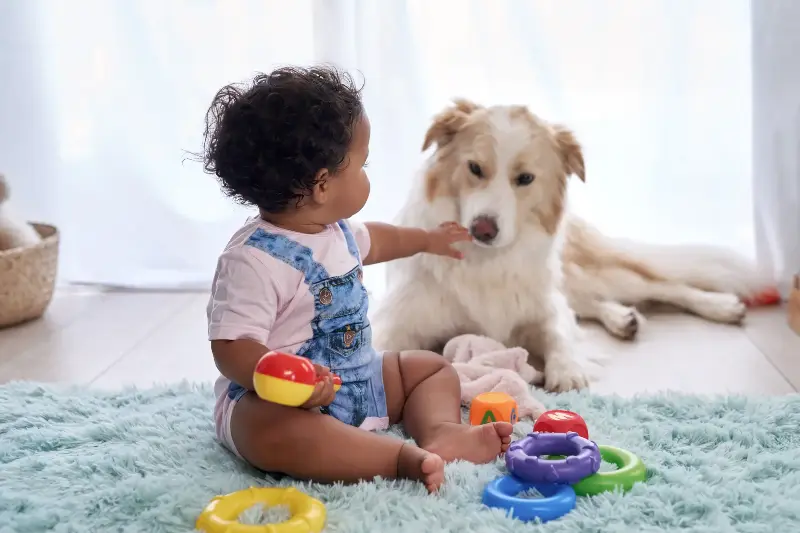
For many families, a dog is a beloved companion.
But new research suggests man’s best friend may offer another unexpected benefit, helping babies stay healthier during their first year of life.
Scientists in Finland have taken a closer look at a long-observed trend: children who grow up around dogs tend to experience fewer infections and require fewer courses of antibiotics.
While previous studies have documented the association, researchers have been trying to understand exactly why it exists.
The answer, it appears, could be hiding in the dust on the floor.
Researchers from the Finnish Institute for Health and Welfare, Kuopio University Hospital and the University of Eastern Finland examined 368 children from pregnancy through their first year of life.
Parents recorded weekly information about their child’s health, including fevers, ear infections and antibiotic use, while scientists analyzed dust samples collected from the family home when the infants were around 2 months old.
The team focused on bacteria and fungi previously linked to dog ownership and investigated whether these microbes could help explain the apparent health advantages seen among children living with dogs.
Their findings, published in the journal Pediatric Allergy and Immunology, suggest that certain dog-associated microbes may partially protect babies against respiratory illnesses.
Eight dog-associated microbial groups individually explained between 10 percent and 23 percent of the protective link between dog ownership and at least one health outcome.
One bacterial genus, Pasteurella, showed the strongest association with fewer weeks of fever.
Researchers also found that three related bacterial groups together accounted for about a quarter of the reduction in antibiotic use seen among infants exposed to dogs.
Interestingly, it was not simply a matter of having more microbes in the home.
The overall richness and diversity of bacteria and fungi in household dust did not appear to explain the health benefits.
Instead, the results point to specific microbes associated with dogs as the key factor.
The researchers concluded that these dog-associated bacterial and fungal genera partly explained the connection between dog ownership and a lower prevalence of respiratory infections during infancy.
According to the study authors, the findings add to growing evidence that the microbial environment encountered during early childhood plays an important role in shaping the developing immune system.
The researchers noted that other factors not examined in the study, such as a more outdoor-oriented lifestyle among dog-owning families or shared household habits, could also contribute to children’s health.
Newsweek reached out to the researchers of this study.
Reference
Mäki JM, Kirjavainen PV, Täubel M, et al. The role of dog keeping in the home microbiota and its impact on children’s health. Pediatr Allergy Immunol. 2026; 37:e70408. doi:10.1111/pai.70408