



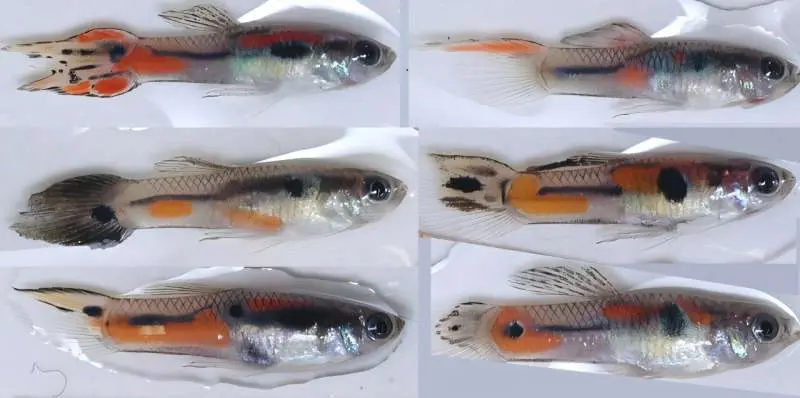
When it comes to choosing a partner, some species prefer males that stand out from the crowd. Evolutionary biologists call the resulting process negative frequency-dependent selection. It means that a male has a huge mating advantage when his appearance is rare but loses that advantage if his look becomes too common. This constant balancing act may be one important reason for the variety in nature.
In a review published in the journal Philosophical Transactions B, researchers examined evidence for female preference for rare or novel males, using guppies (Poecilia reticulata) as a case study. That's because there is an extraordinary variety among guppies, with no two looking the same. The findings could help explain how variety is preserved across many species.
Digging through the archives
Mitchel James Daniel of Florida State University and F. Helen Rodd of the University of Toronto analyzed decades of research, including laboratory experiments, field studies, and studies tracking traits over generations. Their aim was to come up with a possible explanation for why this preference for rare males exists in guppies.
"It is now clear that female preference for rare/novel morphs is a real and robust phenomenon ..." they wrote in their paper.
In particular, Daniel and Rodd looked at existing theories, such as females trying to avoid inbreeding or predators, to see which ones hold up. They found support for several ideas, including habituation.
Tuning out
In psychology, habituation is a process in which an organism decreases its response to repeated, inconsequential stimuli. For example, if you live near a clock tower, you eventually stop noticing the hourly chimes because your brain tunes them out.
In the case of guppies, a similar thing happens visually. When a female is surrounded by dozens of males with similar orange spots, her brain may become less responsive to these familiar patterns. These males essentially become background noise, which makes a rare male, say one with blue or black markings, instantly pop out and catch her eye.
"We believe the existing literature provides compelling evidence for a female preference for rare/novel morphs in guppies that helps to explain the extreme genetic polymorphism in male color patterns," said the researchers.
If the novelty-seeking explanation is correct for guppies, it could also be true for other species. However, as Daniel and Rodd note in their paper, other theories cannot be ruled out completely, and multiple evolutionary forces could be at play.
Written for you by our author Paul Arnold, edited by Gaby Clark, and fact-checked and reviewed by Robert Egan—this article is the result of careful human work. We rely on readers like you to keep independent science journalism alive. If this reporting matters to you, please consider a donation (especially monthly). You'll get an ad-free account as a thank-you.
Publication details
Mitchel James Daniel et al, Origins and significance of preference for rare/novel male morphs: Trinidadian guppies as a case study, Philosophical Transactions B (2026). DOI: 10.1098/rstb.2025.0189
© 2026 Science X Network
Citation: Why female guppies prefer rare males and how this might shape evolution (2026, June 24) retrieved 24 June 2026 from https://phys.org/news/2026-06-female-guppies-rare-males-evolution.html
This document is subject to copyright. Apart from any fair dealing for the purpose of private study or research, no part may be reproduced without the written permission. The content is provided for information purposes only.