



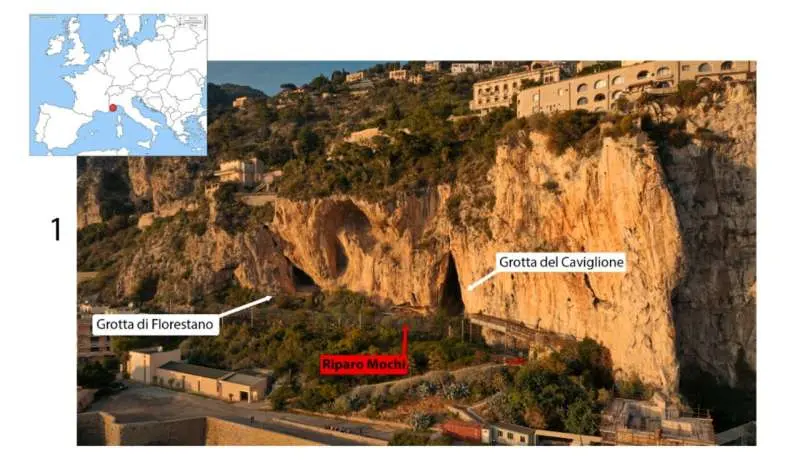
A fresh excavation of the eastern deposit at Riparo Mochi, a rock shelter near today's French–Italian border, has pushed back the timeline for when Ice Age hunter-gatherers from Spain first entered Italy.
Twentieth-century excavations at Riparo Mochi helped establish the site's connection to the Noaillian, a distinct Middle Gravettian culture recognized by its characteristic stone tools, particularly the Noailles burin, which is a small, specialized stone tool. Earlier archaeological evidence had suggested that the culture spread eastward from northern Spain and France into Italy. Riparo Mochi, located along the narrow coastal corridor between France and Italy, offered an important site for researchers who wanted to reexamine the artifacts found in this region with a modern lens.
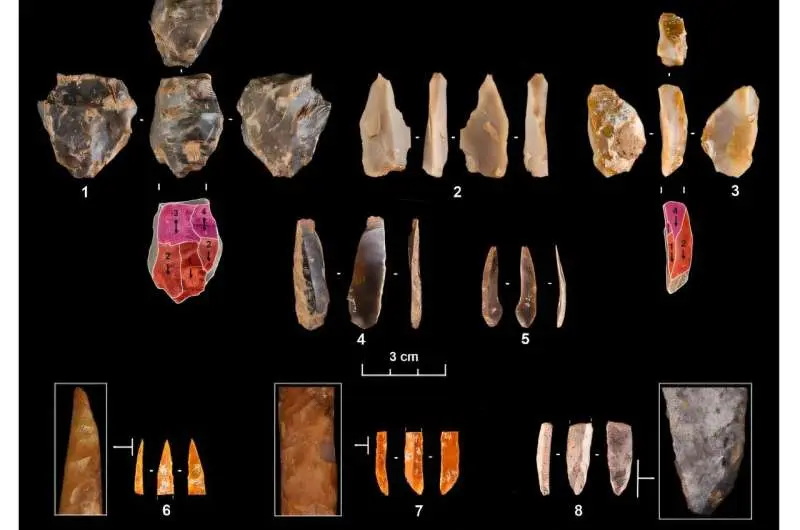
A study of a recent excavation published in the Journal of Archaeological Science: Reports uncovered several new things from the site, including an intact ancient hearth surrounded by marine shells, Noailles burins and tools used for domestic activities and butchery.
Examination of the retrieved material using high-powered digital microscopes revealed tiny chips and wear marks on the recovered tools, offering clues to how they had been used. Archaeologists had long assumed that burins were designed to engrave or groove hard materials such as bone and antler using their pointed tips. Yet the researchers found no signs of wear on these chisel tips. Instead, microscopic wear along the long, razor-sharp side edges pointed to cutting soft animal tissues, including meat and skin.
The marine shell embedded in the sediment surrounding the hearth offered another important clue. Radiocarbon dating placed the shell at around 30,000–30,800 years ago, pushing the site's Noaillian timeline back by roughly 2,000 years. This makes Riparo Mochi the earliest recorded site of Noaillian occupation in Italy.
Fresh look at underground clues
Archaeological evidence suggests the Noaillian culture moved steadily from west to east, spreading from northern Spain and France into Italy. This made Riparo Mochi particularly important. The narrow coastal corridor on the French–Italian border would have been the route the Gravettians, the Upper Paleolithic hunter-gatherer populations that inhabited Europe during the Ice Age, had to take to reach Italy.
Yet the older radiocarbon dates turned this proposed path into a paradoxical curveball. They placed the Noaillian in southern Italy as early as 31,000–30,000 years ago, while at Riparo Mochi, much closer to France, it seemed to have arrived only around 28,000 years ago. Having the culture appear deep in southern Italy 2,000–3,000 years before reaching the supposed entry gate made little sense.
Much of what archaeologists knew about Riparo Mochi came from excavations conducted between 1938 and 1959. Excavation techniques have evolved over the last few decades, with researchers following the natural boundaries of soil rather than removing layers using broad artificial levels. During the earlier excavations, fine sediments were rarely sieved.
To get a clearer picture of Riparo Mochi's past, the team returned to the site and excavated it using modern archaeological methods. They mapped the exact 3D coordinates of every artifact and water-sieved all the excavated soil through a fine mesh, recovering tiny bone fragments, bladelets and stone-chipping debris that might otherwise have gone unnoticed.
They examined over 7,500 tiny stone artifacts like cores, blades, waste chips and debris found around the hearth and neighboring layers to see how tools were manufactured.
Rethinking the timeline
Fresh evidence pushed back the date of arrival at Riparo by 2,000 to 3,000 years. The authors suggest that the Noaillian culture arrived as a complete behavioral system, rapidly replacing existing local patterns rather than blending with them. This points to an expansion driven by actual human migration into sparsely populated coastal lands, rather than the spread of the culture through trade alone.
Microscopic use-wear analysis of tools found around the hearth revealed how the tools were used. For example, microgravettes were fitted onto shafts as tips for hunting weapons. Scrapers and wedges were used to shape wooden shafts and to split bone, either to get at the marrow or to make blanks for bone tools.
The arrival of the hunter-gatherers at the Riparo Mochi corridor coincided with Greenland Stadial 5.1, around 30,500 years ago, when Europe's climate turned suddenly cold and dry. The harsh conditions likely pushed humans to migrate eastward along the Mediterranean coast, toward milder refuges in Italy.
Written for you by our author Sanjukta Mondal, edited by Sadie Harley, and fact-checked and reviewed by Robert Egan—this article is the result of careful human work. We rely on readers like you to keep independent science journalism alive. If this reporting matters to you, please consider a donation (especially monthly). You'll get an ad-free account as a thank-you.
Publication details
Fabio Santaniello et al., New insights into the diffusion of the Gravettian in Italy: the earliest Noaillian evidence at Riparo Mochi (Balzi Rossi), Journal of Archaeological Science: Reports (2026). DOI: 10.1016/j.jasrep.2026.106131
Who's behind this story?

Sanjukta Mondal
Master's in Chemistry. Freelance science journalist and communicator. Published in Chemistry World, BioSpace, and The Hindu. Full profile →

Sadie Harley
BSc Life Sciences & Ecology. Microbiology lab background with pharmaceutical news experience in oil, gas, and renewable industries. Full profile →

Robert Egan
Bachelor's in mathematical biology, Master's in creative writing. Well-traveled with unique perspectives on science and language. Full profile →
© 2026 Science X Network
Citation: Ice Age camp reveals hunter-gatherers reached Italy thousands of years earlier than previously thought (2026, November 10) retrieved 10 November 2026 from https://phys.org/news/2026-11-ice-age-reveals-hunter-italy.html
This document is subject to copyright. Apart from any fair dealing for the purpose of private study or research, no part may be reproduced without the written permission. The content is provided for information purposes only.