



Just as a leaf drifts along with a stream, objects in other moving fluids normally drift along with the flow. That is, unless they exert energy to move against it. Although it may be less intuitive, light waves or photons work similarly. To move against a stream of light, an object or particle, like a photon, must either have an external force acting on it or actively use energy to move upstream.
In a new study, published in Physical Review A, a team of physicists demonstrates how a beam of light can "swim" upstream in a quantum fluid of light by breaking action-reaction symmetry and reshaping how the surrounding forces affect the flow.
Non-reciprocal interactions and upstream motion
Matter is not in equilibrium when it is actively creating a force to oppose motion, like a motorized boat moving up a river. Newton's third law of motion states that for every action, there is an equal and opposite reaction. This is also known as action-reaction symmetry.
Action-reaction symmetry is not broken just because something is out of equilibrium, but this symmetry can be broken when particles exhibit non-reciprocal interactions. In these interactions, one object influences another differently than the other influences it. In non-reciprocal interactions, internal interactions can be converted into net momentum.
Scientists have proposed that these unusual interactions could create active behavior in quantum-like systems. Upstream motion has been demonstrated in previous experiments, but the mechanism involved vortex shedding, which imparts a net upstream recoil momentum and still obeys Newton's third law. The new study is the first to use non-reciprocal interactions, violating action-reaction symmetry.
A swimming light beam driven by nonreciprocal interactions
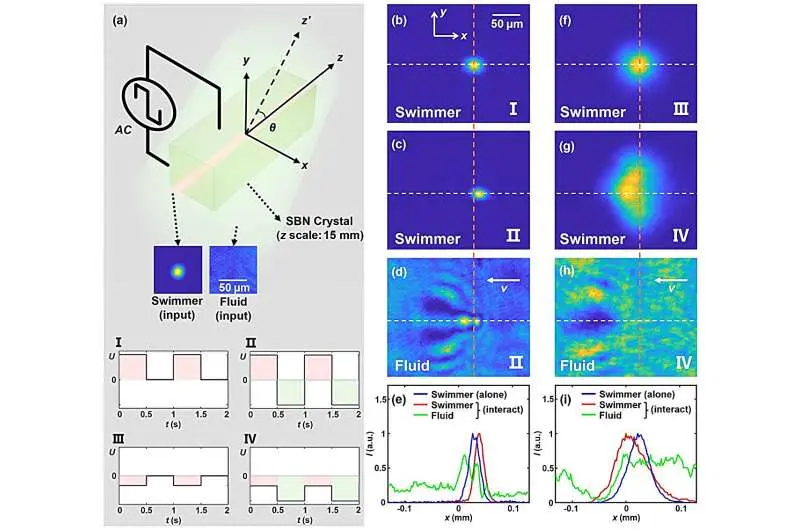
The team involved in the new study combined theoretical scattering analysis, computer simulations and laboratory experiments. They sent two timed laser beams through a nonlinear crystal, with one representing the fluid and the other representing the swimmer. By tilting the fluid beam, they were able to control its transverse flow direction and speed. In their experiments, the narrow laser beam, acting as the swimmer, moved opposite to the flow of a broader optical fluid. In the usual reciprocal setup, the beam instead moved downstream, providing a direct comparison.
The study authors write, "The swimmer tends to reshape the fluid, passing through it asymmetrically, which in turn exerts on the swimmer a force opposite to the fluid flow direction. Such a counterintuitive process stems from the nonreciprocity of their mutual interactions, which results in an inverted recoil compared to that in equilibrium systems."
The upstream motion is due to the asymmetric distribution of the fluid caused by the swimmer. The intensity of the fluid on one side of the swimmer is higher than that on the other side. By adjusting fluid speeds and densities, they also found that the upstream motion was strongest at intermediate fluid speeds and densities, rather than at the highest or lowest values.
The experiments involved an optical analog of a quantum fluid, not a demonstration using material quantum fluids such as ultracold atoms or liquid helium. However, the study offers a test bed for studying active-like behavior under non-reciprocal interactions. Future research could test whether related effects occur in other quantum platforms, such as atomic gases or engineered quantum materials.
The study authors write, "This study advances the fundamental understanding of nonreciprocal interactions in the quantum regime, providing key insights for designing novel quantum devices with active functionalities."
Written for you by our author Krystal Kasal, edited by Gaby Clark, and fact-checked and reviewed by Robert Egan—this article is the result of careful human work. We rely on readers like you to keep independent science journalism alive. If this reporting matters to you, please consider a donation (especially monthly). You'll get an ad-free account as a thank-you.
Publication details
Siyu Li et al, Active upstream motion in a quantum fluid of light arising from nonreciprocal interactions, Physical Review A (2026). DOI: 10.1103/lwyj-7m5f
Who's behind this story?

Krystal Kasal
Freelance science writer with Master's in physics. Five years clinical research and physics education experience. Science communicator. Full profile →

Gaby Clark
MA in English, copy editor since 2021 with experience in higher education and health content. Dedicated to trustworthy science news. Full profile →

Robert Egan
Bachelor's in mathematical biology, Master's in creative writing. Well-traveled with unique perspectives on science and language. Full profile →
© 2026 Science X Network
Citation: Light beam 'swims' upstream through a quantum fluid by violating Newton's third law (2026, September 22) retrieved 22 September 2026 from https://phys.org/news/2026-09-upstream-quantum-fluid-violating-newton.html
This document is subject to copyright. Apart from any fair dealing for the purpose of private study or research, no part may be reproduced without the written permission. The content is provided for information purposes only.