



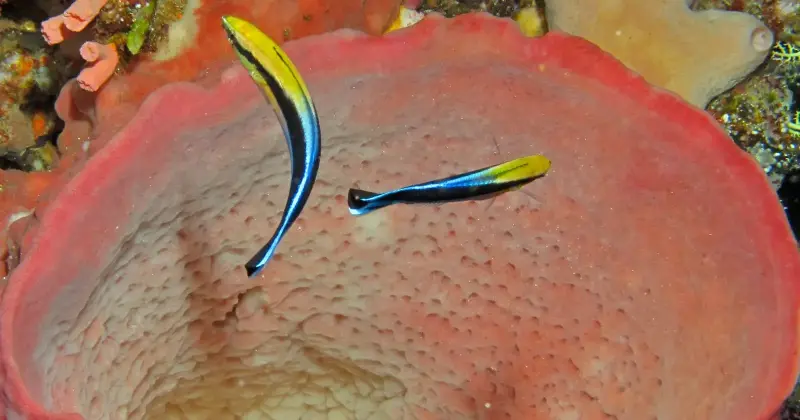
Give most animals a mirror and they treat the reflection as another animal, to court or to fight. A handful of species seem to do something stranger. They appear to work out that the figure in the glass is themselves. For decades that short list ran to great apes, dolphins, elephants and a couple of birds, and the boundary was widely read as a line between minds that have a sense of self and minds that do not.
Then a small coral reef fish crossed it. In a 2019 study, a team led by Masanori Kohda at Osaka City University reported that the cleaner wrasse, Labroides dimidiatus, showed behavior that meets the criteria of the mark test, the standard laboratory check for mirror self-recognition. When the researchers put a colored mark where a fish could see it only in a mirror, three of the four marked fish tried to scrape it off their own bodies. The same scientists were careful about what that did and did not mean, and stopped short of calling the fish self-aware.
A test built for chimpanzees
The mark test was devised in 1970 by psychologist Gordon Gallup. An animal is exposed to a mirror, then marked with a dab of dye somewhere it cannot see without the mirror, such as a brow or an ear. If the animal looks in the glass and then touches or rubs the mark on its own body, the reasoning goes, it must understand that the reflection represents itself.
Over the decades a short and famous list of animals cleared it: chimpanzees and the other great apes, a dolphin, an Asian elephant, and magpies. A few other claims, such as unusual mirror behavior in manta rays, were reported but stayed contested because no proper mark test was run.
The test was built around primates that can reach up and touch their own faces, and it has always carried argument with it. A fish has no hands, no flexible neck and a visual system unlike ours, so the deeper question the study raised was whether the test can be applied fairly across such different animals at all. Before this work, no vertebrate outside mammals and a single bird species had passed it.
What the fish did
The fish were given a mirror and watched over weeks. At first they behaved as most animals do. Seven of the ten attacked their reflection, mouth fighting with the stranger in the glass, and that aggression spiked on the first day and faded to nothing within about a week.
Next came a phase that is harder to explain away. The fish began performing odd, repeated movements in front of the mirror that they almost never showed otherwise, including swimming upside down. Behavior like this is read in apes and elephants as an animal testing the link between its own actions and the movements of the reflection.
The decisive step was the mark. The researchers used a small colored tag injected just under the skin, with a clear sham mark and a colored mark seen without a mirror as controls. When a fish was marked on the throat, a spot it could glimpse only in reflection, it spent far more time angling its body in front of the mirror to bring the throat into view. The posture measurements were checked by independent observers, including blind coders who scored a subset of the videos without knowing which mark a fish carried, to guard against wishful reading.
Then the fish swam down and scraped its throat against the sand or a rock, the way these fish rub off skin parasites. Three of the four throat-marked fish did this, producing 37 separate scrapes, and none of them scraped during the control conditions. That hit rate is in line with other species that have taken the test, where one of three elephants and two of five magpies passed.
Self-aware, or scratching at a spot
This is where the study turns careful, and where it has drawn the most fire. The most striking thing about the paper is that its own authors refused the grandest reading of their data. Passing the mark test, they wrote, does not by itself prove the fish is self-aware. They argued instead that the simplest explanation invokes the fewest assumptions, and that the result may say as much about the limits of the test as about the inner life of the fish.
Critics, including Gallup himself, pushed in a different direction. The mark used on the wrasse resembles an ectoparasite, a small skin parasite, and cleaner wrasse make their living picking exactly such parasites off other fish. A fish that sees a parasite-like spot on its body and tries to scrape it off may be running a hardwired grooming routine triggered by a visible blemish, not recognizing a self in the glass. The injected mark also touches the skin more than a smear of dye on an elephant, raising the chance that the fish felt something at the site.
The journal published the report alongside an accompanying commentary by the primatologist Frans de Waal, who had handled the paper as editor, precisely because the result was contentious and the reviews were split. The disagreement is not really about whether the fish scraped. It is about what scraping means.
A second round with more fish
Rather than let the debate stall, the Osaka group ran a larger follow-up. In 2022 they reported that more cleaner wrasse, tested with ecologically relevant marks, again behaved as though they noticed marks visible only in the mirror, and added experiments aimed at the parasite-instinct objection. Supporters read the replication as the result holding up. Skeptics read it as a richer description of an impressive but still ambiguous behavior. Both can point to the same data.
What almost no one disputes anymore is the lower-stakes claim underneath the headline, that fish are far more cognitively capable than the old picture allowed. Wrasse and their relatives show feats of memory, learning and social calculation that would have seemed absurd to attribute to a fish a generation ago.
What a fish in a mirror leaves unsettled
The cleaner wrasse did not so much answer the question of animal self-recognition as expose how shaky the question’s main tool has become. If a behavior counts as self-directed in an elephant, it is hard to say with a straight face that the same behavior is mere reflex in a fish, unless there is an objective standard that holds across species, and there is not yet one. Either the mark test reaches further down the tree of life than anyone expected, or it was never the clean window into self-awareness it was taken to be.
That is an uncomfortable place to land, which is probably why the little fish on the reef keeps turning up in the argument. It scraped at a mark it could only have seen in a mirror, and then left the harder question swimming in place.
The post Shown its reflection in a mirror, a small reef fish scraped at a mark it could see only there, behaving as if it recognized itself – though the researchers stopped short of calling it self-aware appeared first on Space Daily.