



Some of our oldest geological wonders are far from rock-steady. Spewing, spluttering, exploding or quietly oozing, volcanoes signify our planet is alive.
Eruptions can cause devastation and even bring the globe to a standstill – as was demonstrated by Iceland’s unpronounceable Eyjafjallajökull in 2010. But they also have the power to create, crafting new landscapes and leaving behind fertile soils in their wake.
They have fascinated humans for centuries. Respected by Romans, worshipped by Hindus and rhapsodised by modern travellers, volcanoes are an unstoppable force. Author Jules Verne presented them as a portal to a subterranean world in his classic sci-fi novel Journey to the Centre of the Earth.
Despite the dangers, witnessing them up close is fascinating, awe-inspiring and invigorating. Feel the earth tremble at one of the following volcanoes for definitive proof that nothing on this planet is ever settled.
Mount Bromo, Indonesia
Large enough to hold a desert, the collapsed caldera of this sacred Hindu site features a scattering of volcanic cones and a secret temple emerging from ashen plains. Drive across the “Sea of Sand” in a 4x4, on a motorbike or on horseback to ascend a series of 253 concrete steps and stare directly into an active crater. Sulphurous white smoke billows in thick plumes, rising high above the surrounding emerald jungle.
For an alternative perspective, climb nearby Mount Penanjakan to witness Bromo set against a backdrop of peaks disappearing into the mist. Once a year, thousands of Tenggerese pilgrims trek to the rim and throw offerings of rice, vegetables, fruit and even livestock into the crater. Bromo is a volatile beast – a three-month eruption in 2015 caused economic ruin, and ash clouds have been known to halt international flights.
How to do it
Audley offers a 15-day Discovering Java and Bali tour from £5,210pp, including flights.
Lassen Volcanic National Park, USA
Magma boils and bubbles underground in a variety of ways, giving birth to wildly different volcanoes. Shields are broad and flat; cinders are steep and cone-shaped; domes are bulbous; and stratovolcanoes are almost perfectly symmetrical.
Score an A-grade in geology after wandering through this northern Californian national park, the only place in the world where all four major types are present. Active for a brain-busting three million years, it sits at an intersection of tectonic plates and features spluttering mud, belching fumaroles and fizzing steam vents at the Bumpass Hell hydrothermal area.
One of the best photo spots for capturing Lassen Peak, the park’s snow-dusted signature landmark, is reflected in the Manzanita Lake. Prone to heavy snowfall, there are permanent patches of ice even throughout summer.
How to do it
Discover North America offers a 17-day self-drive Northern California Highlights holiday from £1,595pp. Flight and car hire extra.
Piton de la Fournaise, Réunion
While many Maldivian islands are threatened by rising sea levels, another Indian Ocean idyll is exploding in size. Earlier this year, Réunion’s hyper-active Piton de la Fournaise produced a lava flow powerful enough to reach the sea, extending the coastline by up to 190m.
One of the world’s most active volcanoes covers 40 per cent of the remote French overseas department. A changing landscape means the six-hour hike to the crater edge is ever-evolving. An easier option is to take a scenic helicopter ride for views above the 2,600m crater.
Closer to sea level, a guided walk – or crawl – through ancient lava tunnels follows the path of previous eruptions. Walls are decorated with lava stalactites, drip marks and subterranean stalagmite gardens – a dramatic contrast to the thick jungle covering most of the tropical island.
How to do it
A 16-night Reunion self-drive holiday with Rainbow Tours costs from £2,950pp, including flights and car hire.
Mount Etna, Italy
Ancient Romans had a novel explanation for rumbles in the Earth’s tummy. They believed that Vulcan, the god of fire and metalworks, was hard at work in his forge – later lending his name to nature’s own searing-hot foundries.
Business must have been good below Europe’s tallest volcano, where activity has been bubbling away since ancient times. Promising frequent electrifying displays, it can be seen on foot via a cable car, by cruise ship, or on the Ferrovia Circumetnea railway, which offers views from all sides. During the winter it’s even possible to ski or snowboard down its slopes.
Barren volcanic desert descends into dense forest and fertile foothills scattered with citrus orchards, olive groves and vineyards. One of the oldest wine regions in Italy was reputedly cultivated by Bacchus and continues to produce a “nectar of the gods”.
How to do it
Kirker Holidays offers a three-night stay at Monaci delle Terre Nere on the lower slopes of Mount Etna from £798pp, including flights and car hire.
Mount Fuji, Japan
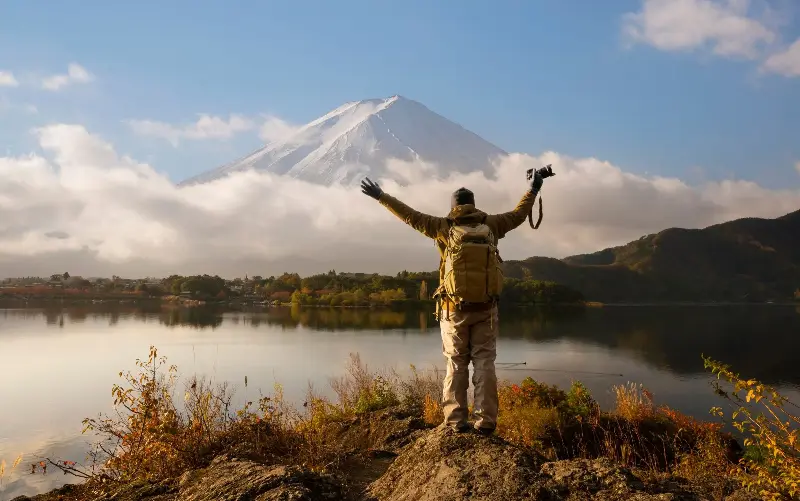
Orderliness and harmony are central to Japanese culture. Suitably, the nation’s most famous mountain is almost perfectly symmetrical. Rising from main island Honshu, it has inspired countless artists, including Katsushika Hokusai.
Recognised by Unesco for its cultural value, the scenic slopes attract more than 200,000 climbers every year, who come to witness the goraiko – the “honourable arrival of light” – at its sacred summit. Trails for the two-day hike open from July 1 to early September. Equipped with the most mountain huts and medical stations, Yoshida is the most popular route.
How to do it
G Adventures offers a 12-day Active Japan: Mt Fuji and Hokkaido escorted tour from £3,896pp. Flights extra. Various departures between July and September.
Ol Doinyo Lengai, Tanzania
Although dwarfed by Kilimanjaro, Africa’s tallest peak, there’s another summit in East Africa’s Rift Valley more precious to the Maasai people. Set on the shores of Lake Natron, a caustic blood-red salt lake capable of turning creatures to stone, is both a spiritual and geological marvel.
Unlike other volcanoes, a unique carbonatite lava flows in oily black streams from the “Mountain of God”, eventually transforming into a white powder and falling like snow.
Despite the apparent dangers, it’s safe to climb – although most treks are done overnight to avoid the intense heat of the day. Gaze into the caldera at dawn to see zebra-striped walls streaked with ash. Combine with a trip to Natron, where millions of lesser flamingos have miraculously evolved to use the deadly waters as a breeding site.
How to do it
Benson Safaris Tanzania offers a five-day trek from £1,105pp. Flights extra.
Erta Ale, Danakil Depression, Ethiopia
Plummeting the length of a skyscraper below sea level, a depression of bubbling mud, sulphurous yellow hot springs and electric-blue gases could be the foundations of an ocean bed in millions of years to come. For now, the parched patch of land where three tectonic plates are tearing apart at the seams is one of the hottest places on the planet. Temperatures at the “Gateway to Hell” regularly rise above 50C throughout the year.
Those who can beat the heat are rewarded with an experience so immersive it skirts the boundaries of hazardous. Camp open-air at the base of Erta Ale and hike after dark to watch the Milky Way streak above glimmering fumaroles fed by a lava lake flowing since 1906.
Part of the Afar region on the border with Eritrea, the area is as politically volatile as it is geologically. The Foreign Office (FCDO) currently advises against travel to the region. Once an all-clear is given, only visit with an experienced guide.
How to do it
When the FCDO approves travel to the region, YellowWood Adventures offers an 11-night escorted tour to Ethiopia’s Gheralta Mountains and the Danakil Depression from £2,748pp. Flights extra.
Mount Vesuvius, Italy
Bemused by scenes ahead of him, early chronicler Pliny the Younger documented one of the deadliest eruptions in history. He compared a tall column of cloud rising above the Bay of Naples to the trunk of a pine tree with splayed branches, later leading volcanologists to describe these volatile ejections of debris and hot gases as “Plinian”.
Further to his words, the events of 79AD were permanently preserved in a mountain of ash and mud which rapidly covered Pompeii and Herculaneum. Casts of unfortunate victims, created by pouring plaster into hollow voids left by decomposed bodies, are displayed in the open-air museum towns, where remnants of mosaic floors, pots of grain and erotic frescoes in a former brothel provide a snapshot of Roman life.
Drive 16 miles from Pompeii to hike up to the crater edge of Vesuvius and admire views of the Amalfi Coast from a place once revered as a living force of nature.
How to do it
KE Adventure offers an eight-day escorted Trails of the Amalfi Coast tour from £1,495pp. Flight extra. Various departures from September to November.
Arenal, Costa Rica
In a catastrophic case of mistaken identity, Arenal turned out to be more dynamic than the local population had once assumed. The rainforest-wrapped “mountain” became one of the world’s most active volcanoes after erupting in 1968. Explosions continued for more than four decades, but smoking plumes have since withered into wisps of gas.
Behind the scenes, geothermal activity heats several mineral-rich hot springs converted into comfortable day spas by a cluster of hotels. The soothing baths provide respite for hikers tackling trails along hardened lava flows cascading down perfect slopes.
A diverse mixture of ecosystems creates a thriving habitat for almost half the animal and plant species found in Costa Rica. Spot sloths dangling from trees, keel-billed toucans flitting through the canopy, and tiny tree frogs lurking in the undergrowth.
How to do it
Latin Routes offers a 12-night Highlights of Costa Rica holiday from £3,999pp, including flights.
Thríhnúkagígur, Iceland
It would be a death sentence to venture inside the belly of a volcano. But by descending 120m below the Bláfjöll mountain range in an open-cable lift, it’s possible to roam through a chamber once filled with gurgling molten matter and emerge to share the tale.
In a rare geological anomaly, magma drained away rather than collapsing or filling the space after this dormant volcano erupted 4,500 years ago. What remains is an eerie cavern large enough to fit the London Eye. Walls are stained with the sunset hues of ancient mineral deposits and water drips metronomically.
Reaching the site, a 40-minute drive from Reykjavik, requires a moderate hike across lava fields. Guided tours operate from mid-May to October.
How to do it
Black Tomato offers the luxury six-night Volcano Adventure in Iceland with exclusive VIP tours from £9,250pp. Flights extra.