



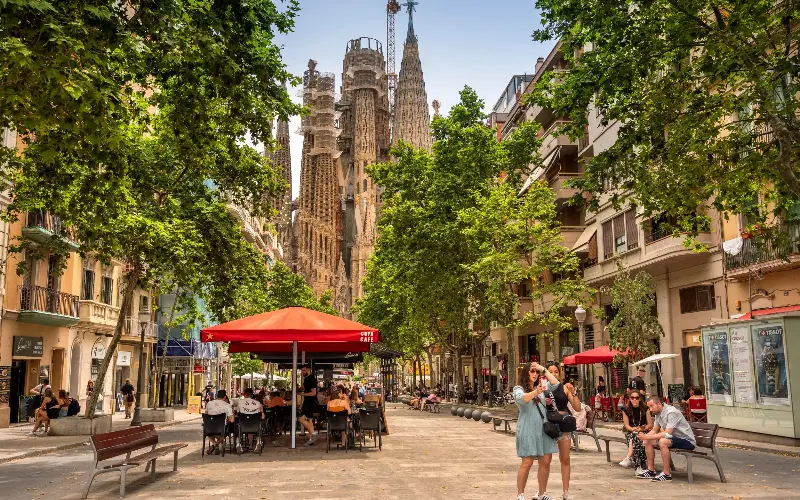
It’s a landmark year for Barcelona, and the city is celebrating by doubling its tourist tax. The change, effective from April 1, will not be welcomed by holidaymakers, 30 million of whom visit the Catalonian capital – already one of the most expensive cities in Spain in terms of accommodation – each year. More are predicted to visit in 2026 as Barcelona marks the centenary of Antoni Gaudí’s death by finally completing the magnificent Sagrada Família.
The city’s overtourism problems are well known. Residents are fed up with the crowds and say the rise of the short-term letting industry has priced them out. Its steep tourist tax, soon to cost up to €12 (£10.40) per night, can be seen as an attempt to placate locals while raising funds to mitigate the problems brought by mass tourism, such as strained infrastructure. But how does the figure compare with other European cities? And which destinations are steadfastly refusing to follow the tourist tax trend?
We’ve crunched the numbers for the continent’s 50 most-visited cities to find out.
The tourist tax havens
Barcelona’s fee is actually a combination of two tourist taxes. There is a regional charge, which will, from April 1, reach up to €7 per person, per night (up from €3.50), and a €5 per person, per night city surcharge.
As is often the case, the levy varies depending on the type of accommodation in question, but it means that individuals staying in high-end hotels are set to pay €12 per person on top of their nightly room rate. For a couple on a three-night break, that’s an extra €72 (£62.25).
This sort of charge is unusual for Spain, a country normally reticent to do anything except woo tourists. Indeed, a number of its most visited cities – including Madrid, Seville, Malaga, Alicante, Granada, Cordoba and Valencia – do not impose a levy.
Beyond Spain, five other cities do not have a tourist tax: Dublin, Copenhagen, London (for now), Krakow and Warsaw. This means 38 of Europe’s 50 most-visited cities do charge one. So, which has the priciest?
Fixed fees: Milan ties with Barcelona
If we only consider the per-person, per-night, graded yet fixed-price model used in the majority of European cities, it is Italy that takes the crown for the heftiest tourist taxes.
Milan will be matching Barcelona’s €12 per person maximum fee from April, and Rome (€10) is not much cheaper. Seven other Italian cities have nightly levies ranging from €5 to €8 per person.
While Barcelona’s charge will impact significantly more Britons due to the city’s popularity, a recent report from the Civil Aviation Authority showed that Milan was the fastest-growing destination for UK passengers.
Surprisingly, though, Venice finds itself at the lower end of the scale. Its much-criticised €10 “access fee” puts it on a par with Rome, but is only for day-trippers; holidaymakers staying in Venice are only taxed up to €5.
France is less expensive than Italy, but only just. Six of its most-visited cities charge between €4.40 and €4.90 per night, while five-star hotels in Paris tax an amount just shy of the rates seen in Milan and Barcelona (€11.38).
The most modest levy can be attributed to Gdansk, which, unlike its Polish counterparts, requires a local tax equivalent to around 57p.
Four of Europe’s 50 most-visited cities use a per-room (rather than per-person) model: Athens, Thessaloniki, Reykjavik and Brussels. It is unfair on solo travellers, who will, for example, pay up to €15 extra per night for a hotel room in Greece while those in a couple pay €7.50 each. But, despite Iceland being one of the globe’s priciest destinations, Reykjavik’s charge is fairly cheap.
Percentage surcharges: Amsterdam leads the way
A smaller proportion of cities adds the levy on as a percentage of the total accommodation bill, rather than a fixed amount. Coming in cheapest is Istanbul, which adds a 2 per cent tax on stays – so, €4, for example, on top of a €200-per-night room.
Amsterdam’s, meanwhile, is a costly 12.5 per cent, and makes Barcelona’s fee look like a bargain by comparison. If a high-end hotel in the Dutch city costs in the region of £400 a night during the peak summer months, that translates to around £50 extra per room, or £25 per person for two people sharing.
Considering that the maximum individual tourist tax in Barcelona or Milan equates to just over £10 per night for even the most luxurious hotels, Amsterdam’s tax is five times the price and the most expensive of Europe’s major destinations.
The 7.5 per cent charge in Berlin comes next. Despite the levy being smaller and accommodation prices being, on average, slightly cheaper than Amsterdam’s, a one-night stay during high season will still see visitors taxed practically the same amount as those in Barcelona. However, this is tempered by the fact that the price shrinks during less popular months.
Where’s next?
Incurring a tourist tax has become inevitable in much of Europe, and even in cities currently free of levies, plans are in motion to implement them.
London is hoping to bring in a 3 per cent tax on accommodation before the year is out, while both Edinburgh and Vienna are introducing 5 per cent levies from July. Oslo, too, will be charging 3 per cent extra from sometime this summer. And in Seville and Krakow? Campaigns are afoot.
For anyone who objects to paying the levies, it might be time to swap Gaudí’s home turf for a trip to Dublin.