



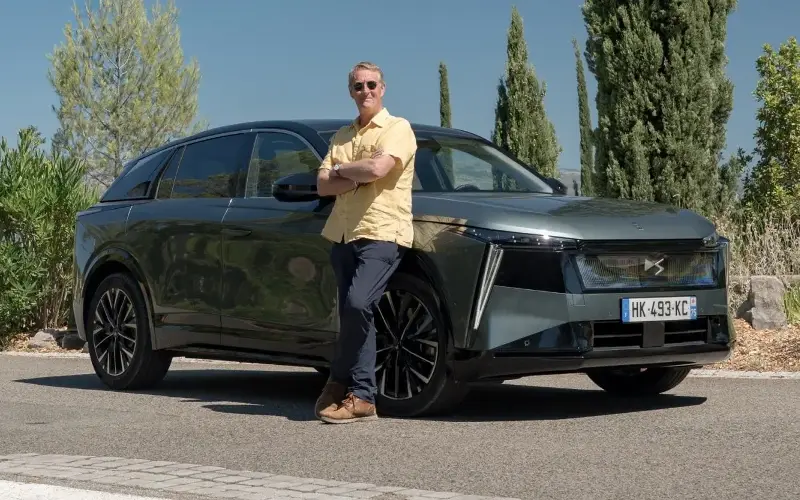
You know there’s something strange about the launch of an important new car when the 24-hour schedule consists of as much glass-blowing and golf tuition as it does driving. Also suspiciously, despite the presence of the entire gamut of engineers, suits and even the arrival of Xavier Peugeot, scion of the eponymous car-making family and DS’s fourth chief executive in a decade, there was precious little opportunity to explore the second generation of the brand’s most popular model with the people who created it.
If you didn’t know already, DS is a made-up French premium marque launched in 2009 by the giant Stellantis Group, based on the reputation built by the incomparable Citroën DS of 1955. Many have expressed doubts about this project, but Stellantis has kept slugging away at the premise that people want to pay a bit extra for a nicer-trimmed but weirder-looking Peugeot/Citroën.
UK buyers haven’t been convinced. Total DS sales in the first six months of this year are 88 per cent down at only 112 cars, against Chery of China’s runaway Jaecoo brand which shifted 34,067 cars in the same period.
Under the skin
Like its predecessor, the DS7 Crossback of 2017, this car has the same underpinnings as the Peugeot 5008, Citroën C5 Aircross and Vauxhall Grandland. All of these fellow Stellantis marques are creditable in their own right, but far from the sunlit uplands of the premium class exemplified by German marques.
DS has pitched the No7 somewhere between the Audi Q4 and Q5, BMW iX1 and iX3, Volvo EX40 and EX60 as well as the Mercedes-Benz EQA and GLC EQ. The French car is larger and more expensive than the smaller class, smaller and a bit less expensive than the larger class.
But there’s no avoiding the big question. Is the DS No7 a premium car? The price certainly is, at £38,920 for the base hybrid rising to £46,890 for the top-model hybrid. EVs start at £49,190 for the 230hp model in Pallas trim, rising to £57,190 for the Étoile trim with front-wheel drive, 245hp and the long-range battery, tested here.
The long-range, all-wheel-drive La Premiere is £66,690. Can they be serious? The well-regarded BMW iX3 costs from only £53,250, while Peugeot’s website has seven-seat 5008s with a 97kWh battery and a range of 411 miles at £45,395. Then there’s the myriad Chinese rivals…
The DS No7 has two battery options, plus a hybrid combustion version, front- and all-wheel drive and five trim packages. Battery models weigh between 535kg and 700kg more than the equivalent hybrid.
The suspension is MacPherson-strut front, with a multi-link rear; electric versions from the Étoile trim upwards have variable-valve dampers with an active-scan system, which will slacken the suspension when a camera spots a pothole or a large bump (although only in the Comfort driving mode).
In this EV long-range form it weighs 2.14 tonnes and tows up to 1.4 tonnes. The 104kW gross lithium-ion ACC battery (which is European made) powers a 242bhp/253lb ft electric motor driving the front wheels giving a WLTP Combined range of 459 miles, a top speed of 118mph and 0-62mph in 7.8sec. Efficiency is quoted at 3.83 miles per kWh, though in practice (very hot weather, driving up and down the Alps Maritime) I achieved 3.5m/kWh, which means a range of 340 miles.
Thierry Métroz, DS design boss, says the shape has given an additional 31 miles of range over the previous model thanks to improved aerodynamics.
Inside information
The interior presents both new and old, which encapsulates DS’s problems. Its design and execution make it one of the high points of the Stellantis Group, however the sliding gear selector is the same as you’ll find on everything from Citroën to Vauxhall. That might be fine if you’re not familiar with the group’s more mainstream brands, but plain cheeky if you are.
The interior design is both comfortable and nicely finished, although idiosyncrasies such as the hidden interior door handles are confusing. The seats are comfortable, but the segment-busting nature of the No7 comes undone when you sit in the back, where accommodation is cramped for adults. You’d squash three across, but only at a pinch.
The boot is decently sized though (560 litres with the rear seats up, 1,570 litres with them folded) and the floor is height adjustable, so you can achieve a near flat load floor.
On the road
It is smooth and refined as you pull away, with good traction at the front and responsive, well-weighted steering; it’s clear that plenty of engineering attention has been lavished. It’s quick without being excessive; when overtaking, you can floor the accelerator without worrying about making your passengers queasy, as some EVs do.
The ride is superficially good, being supple and supportive, but it isn’t quite as wonderful as DS might have you believe. My test car had the 19-inch wheel option, with broader tyre sidewalls providing some extra compliance, but the No7 still clattered off the sharpest bumps and its side-to-side stiffness throws passengers’ heads around. Even the Comfort setting with the dampers at their softest wasn’t enough to assuage the worst surfaces – and roads in the south of France tend to be much smoother than UK ones.
The ADAS driver assistance systems are switchable, although you need to enter the difficult realm of the touchscreen to do so. This is a shame as the regenerative braking can be altered by paddles on the steering column, while a button on the centre console activates one-pedal driving.
The Telegraph verdict
Debuting a lot of electronic stuff from the Stellantis catalogue (semi-automatic lane changing, anyone?) underneath a wacky design does not a premium car make. In that respect you should not regard the DS No7 as inheritor of the spirit of the great French carrosseries (coachbuilders) such as Delage, Delahaye and Figoni et Falaschi. Rather, the No7 (and the whole DS range) represents a chance for company car users to try something a bit different, more design-led, with their salary sacrifices.
I can see why that might be attractive, for the DS is a superficial change from the premium Germans in the sector, however buyers in this upper class of EV SUV now routinely expect a 500-mile range and top-notch driving dynamics. In that respect, the DS No7 simply doesn’t cut it.
The facts
On test: DS No7 Étoile FWD Long Range
Body style: five-door SUV
On sale: autumn
How much? range from £38,920-£66,690 (£57,190 as tested)
How fast? 118mph, 0-62mph in 7.8sec
How efficient? from 3.83m/kWh (3.5/kWh on test)
Powertrain: 104kWh (gross), 97.2kWh (net) lithium-ion NMC battery, AC synchronous permanent-magnet motor with step-down gearing, front-wheel drive
Range: 459 miles (WLTP Combined), 340 miles on test
Charging: 20-80% in 27min on 160kW DC charger, 0-100% in 11hr 30min on 7.4kW household wallbox
Maximum power/torque: 242bhp/253lb ft
CO2 emissions: 0g/km (tailpipe), 23.2g/km (CO2 equivalent well-to-wheel)
VED: £10 first year, £640 next five years, then £200
Warranty: three years/60,000 miles, eight years/100,000 miles on battery
The rivals
Audi Q6 e-tron Sport, from £61,315
Full-size SUV with an 83kW battery and rear-wheel drive giving a range of up to 326 miles, a top speed of 130mph and 0-62mph in 7.6sec. Imposing and handsome, while the interior marks a return to expected Audi standards.
Volvo EX60 PS, from £56,860
This large-ish family SUV is reasonably impressive dynamically as well as being swift, with its 369bhp/354lb ft rear motor. The 83kWh battery gives a range of 295 miles and it fast charges at up to 320kW DC.