



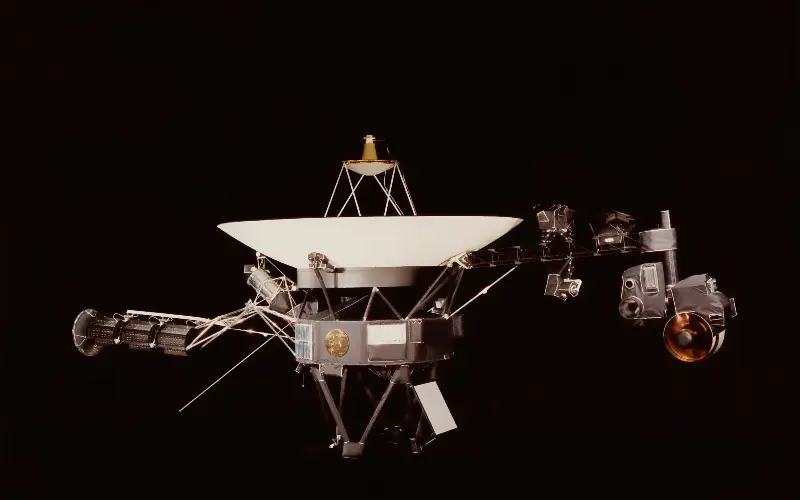
The Voyager 1 space probe will reach one “light-day” from Earth next week, the first time a spacecraft has achieved the milestone.
Next Wednesday, Voyager 1 will be 16 billion miles from home, so distant that light from Earth would take 24 hours to reach the spacecraft.
Nasa is inviting people to help create a “wave of golden light” around the planet by going outside and logging on to a special website that turns their phones into a golden Morse code signaller.
Earth’s golden “hello” will happen the day before the milestone, allowing people to beam Voyager’s “VGR” call-sign into space so that it reaches the spacecraft in time for the celebration.
However, the spacecraft powered off its cameras in 1990, so it will not be able to see the message.
Dr Megan Argo, a reader in astrophysics at the University of Lancashire, said: “After 48 years in space, it’s astonishing that the Voyager 1 spacecraft is still functioning, sending back data and strengthening our understanding of interstellar space.
“The spacecraft’s distance from Earth is now so great that signals travelling between the two take a full day each way. For comparison, light takes just over a second to reach the Moon and 8.3 minutes to travel from the Sun to Earth.
“Although a light-day is an enormous distance by human standards, it is relatively small on an astronomical scale, with the nearest star beyond our Sun more than four light-years away. This demonstrates how immense the distances involved in space are and the challenges of communicating with any potential alien civilisations.”
Voyager 1 and 2 were launched in 1977, and spent 12 years charting the planets in the Solar System before making their way into the Kuiper Belt, which lies beyond Neptune, and towards deep space.
In 2012, Voyager 1 became the first spacecraft to enter interstellar space, leaving the plasma bubble created by the Sun, known as the heliosphere. Voyager 2 exited the heliosphere in 2018.
Although outside the Sun’s influence, the probes are not yet outside the Solar System, and must pass through the Oort Cloud, a region of icy bodies that are still trapped by the Sun’s gravitational pull.
Despite the vast distances, the probes are still communicating with Earth, and continue to return data from interstellar space.
Voyagers ‘represent humanity’s curiosity’
Dr Bill Kurth, a research scientist at the University of Iowa who has been a member of the Voyager science team since 1974, told The Telegraph: “To have sent an operating spacecraft to the distance of one light-day is a profound accomplishment by itself.
“I think what the Voyager missions represent is human exploration on the scale of those by Magellan, Amundsen, Peary, and Lewis and Clark. They represent humanity’s curiosity and wonder about its place in the universe.
“I certainly did not anticipate this mission lasting for nearly 50 years when I first started working on it very early in my career. How many in your readership have a 50-year-old television that still works?”
Nasa’s Jet Propulsion Laboratory (JPL) has been managing the spacecraft for decades and recently sent new commands to shut off non-essential devices and systems to conserve power for the science instruments.
Both Voyagers are powered by radioisotope thermoelectric generators which convert heat from decaying plutonium into electricity. However, the plutonium supply depletes, so the probes lose around four watts of power each year.
The probes set off with 10 working instruments but are now operating with just three. The recent energy savings should provide enough power to keep the instruments running for at least another year.
Voyager 1 is travelling at 38,000 mph away from Earth and its signals are becoming smaller over time. It is expected that by about 2036, radio telescopes will no longer be able to pick up its transmissions.
After next week it will take more than a day for a signal from Earth to reach the spacecraft and return home.
“If you want to say ‘hello’ to Voyager, you send your message and then you go home and you wait two days before you finally get a response,” said Suzanne Dodd, the Voyager project manager at JPL.
To run the golden Morse code signal, visit Nasa’s website.