



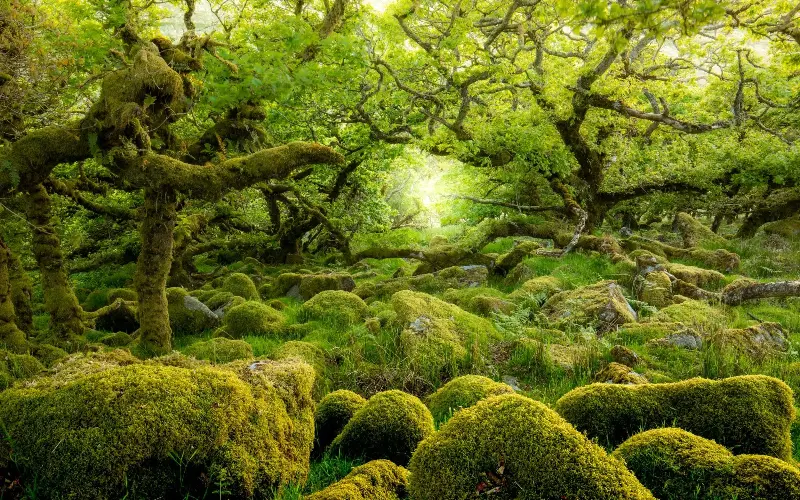
It feels like a green veil has been drawn around you. Everywhere you look something is growing: gnarled tree trunks fuzzed with lichens; damp gullies dripping with ferns; the forest floor thick with spongy moss. This is the scene inside the ancient Atlantic rainforest, the lush woodland that once covered a fifth of the United Kingdom.
Only 1 per cent remains, due to deforestation, grazing, disease and invasive species, but visiting these natural spaces is an incredible – almost otherworldly – experience. Also known as Celtic rainforest, these magical woods could almost have sprouted straight from the pages of Tolkien’s Middle Earth, and indeed inspired the author in creating his vivid fantasy world. Dating back to the end of the last Ice Age around 12,000 years ago, this mysterious, ancient habitat is now restricted to mild and humid pockets in the west.
Many of the remaining fragments are protected in nature reserves and carefully managed to allow visitors access to this rare biome. Tread gently. You’re entering a realm that’s home to over 700 species of mosses, liverworts and lichens, as well as rare fungi, pine martens, red squirrels and migrant birds like pied flycatchers and wood warblers.
1. Wistman’s Wood
Dartmoor, Devon
Hunkered down in a moorland cleft, Wistman’s Wood is a tangle of twisted limbs and jumbled boulders shaggy with moss. When winter mists roll in, it feels primeval and forbidding. But visit in spring and the stunted oaks zing with fresh growth and birdsong. Heed signs to “walk around, not through” the forest to avoid snagging branches and scuffing moss. Instead, sit on the woodland’s edge and fall under its fairytale spell.
How to do it
It’s a gentle uphill 1.5-mile walk to reach Wistman’s Wood from the Two Bridges car park, or The Dartmoor Explorer bus between Exeter and Gunnislake also stops here. The Two Bridges Hotel makes a more convenient base, with rooms from £170.
2. Borrowdale Rainforest National Nature Reserve
Lake District, Cumbria
Stretching south from Derwentwater, this 2.8 sq mile swathe of Atlantic oakwood is slowly spreading thanks to the work of local tenant farmers. Pied flycatchers arrive in early May, migrating from West Africa to nest in tree holes, the forest floor twitches with colonies of northern hairy wood ants and, with patience, you may spot a red squirrel. Be also on the lookout for the rare tree lungwort, a leafy green lichen.
How to do it
Park at Bowder Stone Car Park, or take the 78 bus between Keswick and the Borrowdale Valley, where a two-mile trail weaves through the temperate rainforest of Cummacatta Wood. The Borrowdale Hotel, with rooms from £168, is situated nearby just outside Keswick.
3. Taynish National Nature Reserve
Argyll, Scotland
Barely 50 miles from Glasgow as the raven flies, Taynish protects one of Europe’s oldest oak rainforests. Cloaking a remote peninsula that dangles into Loch Sween, its growing tally of 475 lichens includes 91 nationally scarce species. Add 250 different mosses and liverworts, plus rarities like the narrow-leaved helleborine, red squirrel and pine marten and you have a veritable Eden.
How to do it
From the reserve car park, allow two hours to walk the Woodland Trail through Atlantic rainforest before setting off on the Coastal Path in search of otters, white-tailed eagles and marsh fritillary butterflies.
4. Coed Felenrhyd & Llennyrch Celtic Rainforest
Eryri (Snowdonia), Gwynedd, Wales
This 1.2-sq mile fragment of temperate rainforest has been clinging to the steep banks of the Afon Prysor for thousands of years. With up to 200 days of rain each year, bryophytes (the mosses and liverworts) are in their element here. Look beyond the spring displays of bluebells to find rainforest rarities like barnacle lichen, prostrate signal-moss and even the lesser horseshoe bat.
How to do it
There is a small car park, operated by honesty box payments, at the entrance to the park. Buses also stop at the Maentwrog power station which is located near the main entrance to the woodland. The nearby 17th-century, six-bedroom Grapes Hotel has rooms from £135.
5. Golitha Falls National Nature Reserve
Bodmin, Cornwall
Flowing through the soft, green underbelly of Bodmin Moor, the River Fowey has carved a gorge through ancient rainforest at Golitha Falls. Festooned in more than 120 species of bryophytes and 50 types of lichen, the reserve’s oak, ash, beech and hazel trees bow over a series of rapids and cascades. Sit quietly and watch for otters squirming through tea-coloured pools or plan a dusk vigil in search of rare bats.
How to do it
A level out-and-back path leads from the car park opposite the reserve entrance about two miles from St Cleer. A 15-minute drive away, Wheal Tor Hotel has far-reaching views from the top of Caradon Hill and rooms from £104.
6. Ariundle Oakwood National Nature Reserve
Strontian, Loch Sunart, Scotland
Cloaking the slopes of Strontian Glen, the ancient moss-covered trees of Ariundle form part of the Loch Sunart Oakwoods – the largest continuous area of Atlantic rainforest in Britain. A haven for chequered skipper butterflies (extinct in England since the 1970s), these verdant forests shimmer with wood anemones each spring, hence the wood’s Gaelic name Airigh Fhionndail, meaning “shieling of the white meadow”.
How to do it
Park at the Airigh Fhionndail car park, where a three-mile circular trail follows the Strontian River before climbing into the woodland. The nearby Strontian Hotel looks out across Loch Sunart and has rooms from £154.
7. Coed Cwm Einion
Ceredigion, Wales
Hidden in the hills above Cardigan Bay, this remote and bewitching Celtic rainforest hugs steep valley slopes above the tumbling Afon Einion. Off its 177 species of lichen, the grey-green, lettuce-like Parmotrema robustum is the rarest – found only at three other sites in Britain. Lying at the heart of Dyfi Biosphere Reserve, you can combine rainforest rambles with wildlife forays in the Ynyslas dunes and Cors Fochno peat bogs.
How to do it
Park in the village of Furnace and follow the 3.5-mile Furnace Circular or Artist’s Valley trail into the rainforest. Machynlleth makes a good base; try the Wynnstay, with rooms from £150, for a traditional inn right in the centre of the market town.
8. Ardura Community Forest
Isle of Mull, Scotland
Central to island life for countless generations, Ardura Forest has long been a source of shelter, timber and firewood – but now the Mull and Iona Community Trust is aiming to restore this Atlantic rainforest by removing invasive rhododendron and Sitka spruce, plant native trees and conserve globally threatened species like the hazel gloves fungus. By visiting you can support seed collecting, tree planting and wildlife monitoring.
How to do it
Drive 15 minutes south from Craignure ferry terminal to reach the forest parking area. A gentle, two-hour walk follows the River Lussa and dips into the wildwood. The Isle of Mull Hotel & Spa overlooks the Sound of Mull and has rooms from £251.
9. Fingle Woods
Teign Valley, Devon
Running for over six miles along Dartmoor’s Teign Valley, Fingle Woods is one of England’s largest woodland restoration projects. Wildlife is making a comeback in this leafy mosaic of temperate rainforest, wet woodland and heathland – look out for otters, dormice, pied flycatchers and kingfishers. The views from Hunter’s Path reveal a patchwork of recovering rainforest stretching across the gorge.
How to do it
Follow Hunter’s Path from Castle Drogo to Fingle Bridge, before looping back on the Fisherman’s Path next to the River Teign – a four-mile circuit. In nearby Chagford, Mill End Hotel has rooms from £294 and is also within walking distance of the woods.
10. Uig Wood
Isle of Skye, Scotland
Hike to the waterfall at the head of Rha Glen in this far-flung woodland on Skye’s northwest coast and it can feel like you’ve stumbled upon a lost world. The sheltered, humid microclimate nurtures thick growths of mosses, liverworts and lichens that cling to the trees and rocks like the rampant epiphytes of equatorial jungles. More than a thousand species have been recorded in and around the wood, from flatworms to white-tailed eagles.
How to do it
Start from Uig Community Hall and follow the waymarked Rha Glen trail to the waterfall, but note that paths can be steep, muddy and uneven. Buses run between Portree and Uig, where accommodation includes the 11-bedroom Uig Hotel (rooms from £324).