



Tiles have been around for thousands of years, with the oldest known examples dating back to Ancient Egypt in 4,700 BC. Valued throughout history as much for decoration as durability, they have long been used as a means of embellishment, yet today, we tend to keep this versatile finish confined to floors and splash-zones in kitchens and bathrooms.
Increasingly though, designers are looking beyond these applications, introducing tiles as a means to bring texture, colour and architectural interest to spaces where they might once have been overlooked.
Here, we asked seven experts to talk us through their most inventive tiling projects, and to share their tips for bringing the same sense of creativity to your own home.
Showcase classic tiles on furniture
The team at London-based studio Ben Pentreath channelled the spirit of both the 1960s and legendary interior designer David Hicks when they fabricated the custom coffee table in the TV room of this Cornish Jacobean manor house.
“I’m a huge fan of tiled furniture, and there are some wonderful examples throughout history, from Arts and Crafts Liberty side tables to mid-century Scandinavian coffee tables and pieces by avant-garde Italian architectural firm Superstudio,” says associate director Leo Kary. “To me, a tiled table always feels somewhat unexpected yet supremely practical, and in this scenario, it felt more appropriate than an upholstered ottoman.”
Clad in Balineum’s mottled sponged-effect tiles – commonly found in Victorian pubs – the ochre and turquoise glazes underscore the room’s 1960s-inspired aesthetic. “Tiles can have an objectively utilitarian feel,” adds Kary, “but using them on furniture can really highlight their beauty and showcase them as a design element in their own right.”
Visit benpentreath.com. Mottled tiles from £13.51 for 10cm square, balineum.co.uk
Use dado-style tiles as a finishing touch
For interior designer Nina Campbell OBE, it’s all about the finishing touches. “I always say details are what take a design from DIY to couture, and narrow tiles like these [green ones] are like the piping on a cushion, the fringe on a sofa or braid on a curtain,” she says. “Small, decorative elements make everything feel more considered and complete. Once you have these little dados and trims, you can top and tail a scheme, introduce colour accents and create something that feels really bespoke without overcomplicating it.”
Aside from bathrooms and kitchens, the slender designs can be used to add interest in hallways, living areas, or even bedrooms. “They’re so versatile; you can create borders or introduce stripes, and pairing the dados with wallpaper creates a natural transition that gives the wall a much more tailored feel,” Campbell explains. “Alternatively, introducing a dado in the middle of an expanse of tiles can subtly divide the surface, making the whole design appear much more architectural.”
The Finishing Touches collection by Nina Campbell, from £2.50 per tile for a 1.2cm x 15cm short trim, firedearth.com
Cover architectural features in neat mosaics
In this cheerful and contemporary project, Australian interior designer Jase Sullivan engineered a tiled hearth that blurs the line between furniture and architecture. “You could use the same approach to create shelves or integrated seating – anywhere you want to introduce a strong sculptural detail,” he notes. “Here, we used small-format mosaics, which are ideal as they wrap neatly around curves and edges. These tiles are handcrafted from limestone offcuts, and their varied thicknesses create a beautiful, irregular surface that catches the light. Of course, if you want something completely flat, choose tiles of a uniform height.”
From an installation perspective, Sullivan advises mapping out the tile layout carefully, particularly where curved and straight edges meet. “I was on site when these were being laid, and we spent a lot of time refining the junctions and edge details. These decisions might seem minor, but they’re what separates a beautifully crafted feature from one that feels like a DIY project.”
Visit jasesullivan.com. For similar tiles try Prisma Yellow Quartz Mosaic Sheet, £47 per 30cm×30cm sheet, Mozaico.com
Clad a chimney breast with textural tiles
A chimney breast provides an ideal surface to be bold with tiles, especially if you have a large area to play with. “I love taking a material and using it in a way that feels slightly unexpected,” says interior designer Lesley Taylor. “You might associate terracotta with floors for example, but we wanted this space to have a rustic, Mediterranean feel and these Moroccan Bejmat-style tiles work really well with the limewash walls.”
With an expanse like this, Taylor advises opting for tiles with character rather than anything too perfect, as a little variation stops the surface feeling overly uniform. “This chimney breast is tall enough to carry the repeating geometric pattern, and the small green squares give it just enough bite,” she says. Remember too, with a working fire, always use heat-resistant adhesive and grout, and make sure the surface is properly prepared before installation begins.
Visit lesleytaylordesign.com. Marrakesh Light, £72 per sq m and Marrakesh Brick Green Gloss (cut into squares), £74.67 per sq m, bakedtiles.co.uk
Replace risers and skirting with a cheerful pattern
The brief for this scheme, conceived by designer Petra Palumbo, was to introduce colour and pattern while keeping the overall aesthetic relatively understated.
“The staircase already had such a beautiful sculptural quality, with its sweeping curve naturally drawing your eye upwards, so it made sense to celebrate that,” says Palumbo. “Then continuing the hand-decorated tiles from the risers onto the skirting creates a visual thread that wraps around the space.”
There’s also a practical benefit, as stair risers and skirting boards inevitably receive knocks and scuffs, and glazed ceramic is incredibly durable, making it as functional as it is beautiful. “This approach is influenced by the decorative traditions of Lebanon and the wider Mediterranean, where tiled details have long been woven into the fabric of a building rather than treated as something purely decorative,” she adds. “Beyond their traditional place in kitchens and bathrooms, they become part of the architecture itself.”
Beirut tiles, £24 each, petrapalumbo.com
Create a feature wall in an unexpected place
Bert & May founder Lee Thornley took this bedroom wall in an unconventional direction, opting for a glossy tiled surface. “In a scenario like this, a tiled wall adds character in a way that paint or wallpaper can’t,” he says. “These tiles are ideal because the design creates a sense of movement across the wall and the circles are something a little bit unexpected – the whole thing looks a little bit like a mural.”
An alternative approach, he says, would be to choose something with a lot more texture. “You could achieve a completely different feel with handmade tiles such as zelliges in a single colour, where the natural variation on the surface would create something softer.” Whichever option you choose, when it comes to using tiles in living spaces, he recommends exercising a little restraint colour-wise. “A tip for tiling beyond kitchens and bathrooms is to keep the palette simple as it makes decorating the rest of the room much easier.”
Moclin Arch, Column and Cap Tealish Cement Tile, all £225.54 per sq m, bertandmay.com
Frame a door with a decorative design
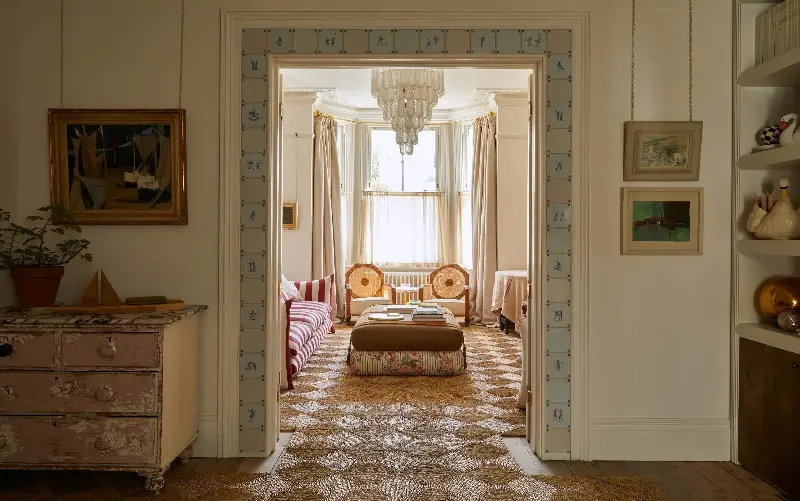
“Tiling around a door is a fantastic way to reimagine the frame as a decorative feature. It transforms the transition between two rooms, creating a detail that enhances the overall interior,” says Angus Buchanan, creative director of multidisciplinary design firm Buchanan Studio. “Here, we chose traditional Delft tiles as they bring a sense of history and craftsmanship, and the blue-and-white palette feels timeless. A checkerboard pattern would also be interesting, or a bespoke hand-painted tile could be especially personal.”
In this North London townhouse, a new opening was knocked through to connect the two reception rooms. “We wanted it to feel in keeping with the Edwardian property and there was already elaborate original moulding in the two adjacent spaces. We added a timber bead trim around the door jamb, then the tiles, and a large timber architrave to finish. You could achieve this look with an existing door by removing any existing door casing, installing the tiles and then reinstating a new one.”
Visit buchanan.studio. For similar tiles try Classic Delft, £34.65 per tile, marlboroughtiles.com