



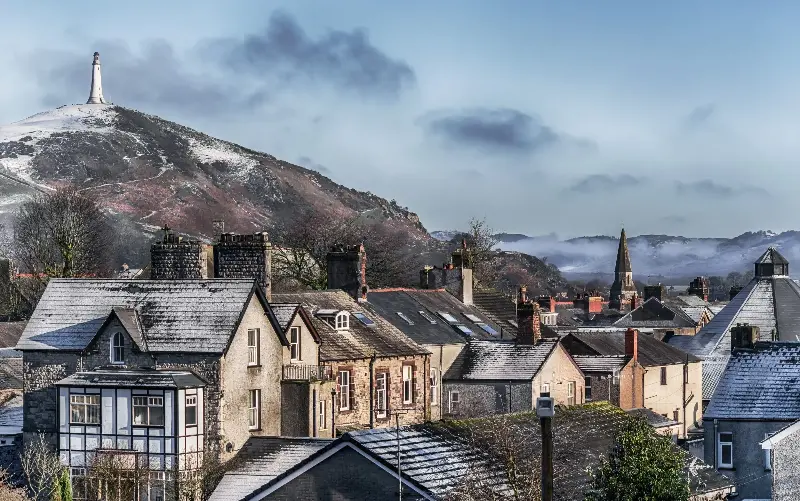
First, there was the “lighthouse” – on a hill, one mile from the sea, and without a light (it’s never had one). Then there was the statue of the vintage comedy duo, Laurel and Hardy, grinning wildly outside the Coronation Hall. The next thing that caught my eye was the pocket-sized gin distillery in the town’s livestock market. So by the time I discovered the canal – the straightest, shortest (1.25 miles) and deepest in England – I wasn’t remotely surprised by stumbling upon another oddity.
Ulverston, a town of some 12,000 souls in Cumbria, goes about its business in its own idiosyncratic way. Despite sitting on the southern edge of the Lake District National Park, 20 minutes from Lake Windermere, it seems untroubled by the meandering crowds of the rest of the Lakes.
“What this town is about,” explains Gavin Knott, “is its ability to think differently.” Gavin, a youthful 76-year-old, career-switched from quantity surveying to running the Appleseeds health food store and therapy rooms, the local Scout group and the quirky annual Lantern Festival (think structures such as a giant Jarvis Cocker, a Titanic liner and a Viking longship).
If novelty lanterns aren’t your thing, Ulverston hosts around 15 other annual festivals, including international music, printmaking, walking, “retro” cycling and a “flag fortnight”, all of which rely on volunteers for their success.
“When I was asked if I wanted to learn a banana dance, and carry giant cardboard bananas with Carmen Miranda’s voice coming over the speakers – well, why wouldn’t you?” laughs Zoe Arnold-Bennett, a reference to her contribution to the town’s comedy and music festival. “Volunteering for events is so much fun!”
Zoe, together with her husband, Andy, runs the Shed One Distillery (primarily gins and vodka), which began in their 7ft by 7ft garden shed. Since 2019, it has operated out of the slightly (but not massively) bigger premises – where it offers tours, gin-making experiences and afternoon “G&Tea” – that once housed calves for the (still-functioning) weekly cattle market.
Virtually all ingredients are locally grown, from “Colin’s heritage apples, sloes and damsons” to quinces and pears from the walled garden in the town’s Ford Park, and the meadowsweet, lady’s smock, gorse, yarrow and wild thyme that Zoe forages.
Even if visiting between festivals, there’s an “en fête” feel to the town. People cheerily carry out conversations across the street, even when they’re walking in opposite directions. Two policewomen on evening patrol startled me with their effusive “Hello!”s. By 9am, folks had already gathered for a coffee and a natter at The Farmers (one of over a dozen pubs in the town), enjoying its heated patio.
The Farmers overlooks Market Street (universally referred to as the “High Street”), a gently sloping cobbled street that offers a joyous collection of independent businesses, including a butcher, a baker and a fishmonger, plus shops selling books, gifts and homewares, and even crystals, tarot readings and hippy-ish clothing.
Working Class Heroes, hawking streetwear fashion amongst its pale floorboards and white walls, wouldn’t look out of place in Manchester. “It’s a slower pace of life here,” says its 22-year-old manager, Euan Hall, whose carefully cropped hair has a fascinating leopard-print colour scheme. “But it’s a nice energy. It’s got a community feel. There’s something nice about going to the pub and knowing you’ll see someone you know.”
Mark Greenhow, 48, agrees: “The town centre has a village feel. I can say ‘Hello’ to ten people just walking up the road.” Ulverston born-and-bred, it was Mark’s grandfather, Bill Cubin, who started the Laurel and Hardy Museum (Stan Laurel – the skinny one – was born in the town in 1890) in a back room of the family’s café in 1983. Cubin’s passion for the pair meant he collected every bit of memorabilia he could lay his hands on, including photographs, film posters, bowler hats and souvenir mugs. “Me and my brother were grandad’s promotional tool. He’d dress us up as little Laurel and Hardy,” recalls Mark.
The museum expanded into the Art Deco Roxy cinema, with Mark stepping up to curator role, and adding more structure to the layout although there’s still Bill’s original collection (“like an overgrown scrapbook,” sighs Mark fondly) in one section. Laurel and Hardy films play continuously – Tit for Tat on my visit – and still make people laugh. Their secret? “Their timing is what sets them apart,” explains Mark. “They perform slapstick and make it believable rather than something to make you cringe.”
Goodness knows what George Fox would have made of them. The founder of the Quaker movement – not known for its high jinks – stayed at Swarthmoor Hall, an Elizabethan manor house just outside the town, in the early 1650s. He had been invited by the Hall’s chatelaine, Margaret Fell, who shared similar religious views; effectively, the hall is where Quakerism began. Although its austere, the wood-panelled rooms, stout furnishings (including Fox’s travelling four-poster bed) and gardens create a sense of calm.
As does the Manjushri Kadampa Meditation Centre, established in 1976 in a sprawling Victorian Gothic Revival mansion two miles from the town. Who would have thought that Ulverston would be chosen as the International Centre for Modern (or Kadampa) Buddhism?
“People say they can pick up on an energy here,” explains Kelsang Yangdon, a Buddhist nun, who moved here from Glasgow in 2008. “They say they can feel a peace.” The Centre runs courses, talks and retreats plus daily – free – meditation sessions, the latter in the temple, rich with light, colour, Buddhas, deities and glittering gold leaf. For 15 minutes, I concentrated on my breathing and tried, as instructed by the session leader, to bring my mind back from its wilful wandering.
Afterwards, refreshed if not enlightened, I took the 10-minute walk through woodland to the sea: the northern edge of vast Morecambe Bay. Be warned that this is not a bucket-and-spade beach – more mudflat-and-pebble – and swimming is inadvisable due to the bay’s notoriously fast tides, dangerous currents and quicksand.
The sea can also be reached from the town along the poker-straight canal. Built in 1796 to export goods including iron ore and slate, and import coal and cotton for the town’s spinning mills, trade declined after the opening of the Lancaster and Furness Railway, and the nearby Barrow’s deep-water port. Still, it’s worth the walk to spot swans, lapwing and oystercatchers – and to watch the trains inching their way over the Leven Viaduct, which strides across the water linking Ulverston’s Furness Peninsula and the Cartmel Peninsula.
For a better view, I climbed up 450ft (137m) Hoad Hill, which rises to the north of the town, and is topped with that light-less lighthouse. A monument to locally born explorer, founding member of the Royal Geographical Society and naval administrator Sir John Barrow (1764-1848), it’s well-loved by locals.
I arrived as the setting sun tinged the clouds pink above a hazy skyline of fells, including Scafell Pike, Coniston Old Man and Ingleborough. Across the bay, a tiny string of lights indicated Morecambe; on an exceptionally fine day, you can see Blackpool Tower. Just another of Ulverston’s little surprises.
Where to stay
Centrally placed, The Farmers offers three self-catering cottages that sleep between two and six (from £148 per night, two-night minimum; the-farmers-ulverston.co.uk).
Where to eat
The Farmers (see above) offers pub classics such as burgers, pizzas and steaks, plus specials such as lamb rump with garlic crushed potatoes; mains average £18.
L’al Churrasco is a colourful, family-run, Mediterranean tapas-style restaurant where all dishes, such as chalk stream trout with watercress pesto, and lamb shawarma with tzatziki, are made from scratch; good vegetarian choices, too. Mains average £11; see lalchurrasco.co.uk.