



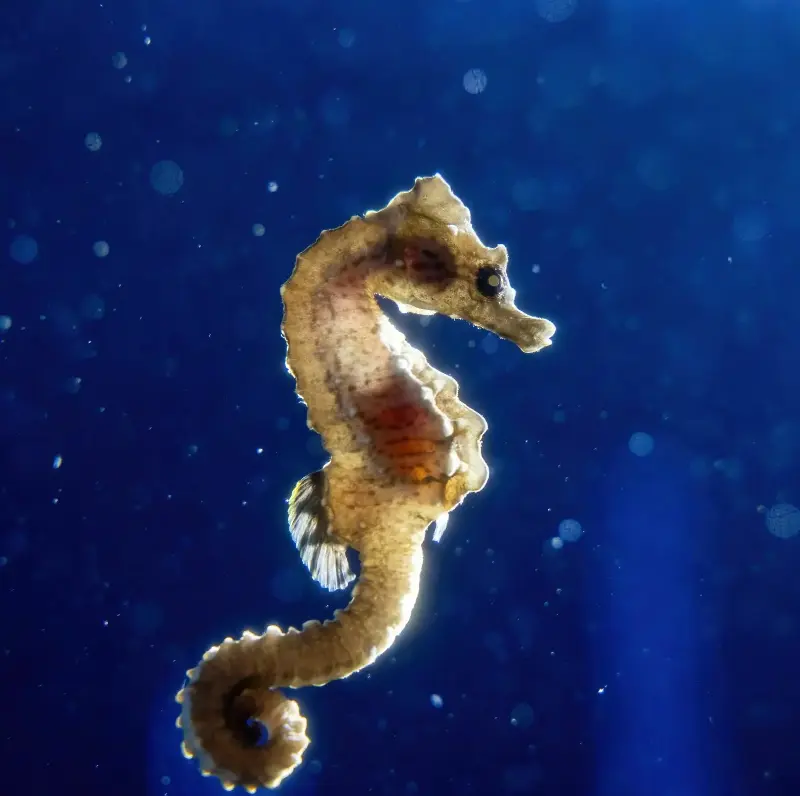
With careful precision, marine biologist Linda Albonetti extracts a 10cm-long injured seahorse – a heavily pregnant male – from an aquarium tank to apply healing ointment to its wound.
Linda, 29, coordinator at the world’s first specialist seahorse hospital, is currently caring for around 50 of these tiny creatures, all of which were brought in by local fishing crews after becoming snagged in their nets.
The seahorse will be kept for a few more days before it is released back into the Adriatic Sea, giving it time to recover from the cut to the soft, bony plates that form its outer carapace.
What the team here are doing is a literal drop in the ocean, a small attempt to fight back against the potential extinction of these remarkable fish.
In Europe and around countries like Indonesia, they are being poached in their millions for sale to a voracious Asian traditional medicine market where they are consumed as an aphrodisiac and alleged cure for impotence, asthma and kidney problems.
“There is definitely a downward trend in the overall seahorse population because they are being collected for the Asian market,” says Linda. “Technically, they cannot be exported to countries such as China, but there is no specific law preventing that trade. They do not have the same protections as sea turtles, for example.
“It is not happening in this part of Italy yet, but it is further south, off the Mediterranean coast. That is why it is so important that we monitor their numbers and maintain a good relationship with the local fishermen.”
The Seahorse Rescue Centre conservation project in Ravenna, based in the town’s former fish market, was set up in 2019 by Italian conservation organisation the Experimental Centre for the Protection of Habitats (CESTHA). Since its inception, more than 8,000 seahorses have been saved.
Linda and her team care for two different seahorse species found nearby, which are white, yellow and brown in colour. Fully grown, they do not reach more than 15cm in length, so are often hard to spot.
The main injuries they tend to are deep cuts to the seahorses’ tails, which would kill them if left untreated. Sometimes the tails have become completely severed. In most cases, a few delicate dabs of the restorative gel and time in the rehab tank is enough to restore the fish back to full health. Some suffer anoxia (a lack of oxygen) because of their injuries.
Although local fishing trawler crews were initially sceptical, they now work closely with the rescue team, handing over any seahorses which they find in their catch when they come back to port in the morning.
Local fishermen use box wire mesh traps to catch cuttlefish, which seahorses easily drift into. During the summer months, when seahorse numbers are at their highest, dozens are handed over every week.
Davide Rosetti, 25, who started helping out on his father’s boat when he was just five years old, passes Linda a bucket containing two seahorses which he has unpicked from the nets. Other members of the crew load up crates of cuttlefish and sea bream on the jetty.
“We’re happy to do our bit,’ says Davide. “Sometimes we will bring back 20 from a single outing, even more when we are fishing close to the shore.”
As well as treating fully-grown adult seahorses, there is also a special tank for babies, so tiny they are at first hard to spot.
Before they are released, the seahorses are tagged with drops of ultraviolet paint, which Linda applies with a small instrument similar to a tattoo gun. This enables them to establish whether the population is stabilising.
The release takes place in a shallow brackish lagoon, a protected nature reserve with a wild flamingo population, in which the fish have a better chance of success. Seahorses, which can camouflage themselves to hide from predators, typically thrive among seaweeds and reefs in shallow waters.
The growing international wildlife trade, in which direct connections have been established between Italian fishermen and Chinese buyers, has devastated the population in some coastal areas. Seahorse numbers have drastically declined around the boot of Italy at the southern tip of the mainland.
A 2021 academic paper published in the Frontiers in Marine Science journal identified the Mar Piccolo near the southern Italian city of Taranto as a potential source for illegal fishing.
Packets of dried seahorses are sold at grocery stores in cities like Hong Kong, where they are a widely cherished product. They are also bought as ornaments to display at home. As well as illegal fishing, the fish are threatened by rising sea temperatures.
Despite the success of the Ravenna project, far more seahorses are inadvertently ensnared by nets dragged along the ocean floor by larger commercial trawlers, a practice known as by-catch which is affecting many endangered marine species.
There are nearly 50 species of seahorses worldwide, all of which are listed under CITES Appendix II, which means commercial trade in the species must be strictly documented to ensure its survival in the wild is not threatened. However, most of the trade with China is carried out by clandestine smuggling, without any checks.
They are the only fish in which males rather than females give birth to young. Females put their eggs into a pouch located at the base of a male seahorse’s tail. Males then fertilise the eggs and give birth to live baby seahorses.
Neil Greenwood, Wildlife Rescue Programme Director at the International Fund for Animal Welfare (IFAW), which is supporting the seahorse hospital said: “It might seem an unlikely combination, but this working partnership between scientists and local fishermen returns around 2,000 seahorses to the sea each year – animals that would otherwise have died in the nets as by-catch. It’s proof that people and animals can thrive together.
“Rescue centres like this are increasingly important, because seahorses are in real trouble. Tens of millions are taken from the oceans every year for the dried animal trade and traditional medicine, much of it illegal, while warming seas are quietly degrading the sheltered coastal habitats they depend on. A creature that has survived for millions of years is now struggling to survive us.”
Protect yourself and your family by learning more about Global Health Security